Basic information about the device
If the axis calibration fails, please check the height alignment of the model in the
measuring field. (See page 16, Fig. 18)
11. Basic information about the device
11.1 Functioning of the Activity 850
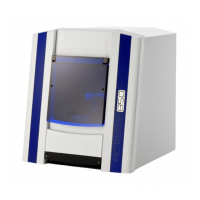
The optical scanner with the designation "Activity 850" is used for the three-dimensional
measuring of jaw models, in orthodontic and prosthetic applications.
The most important components of the scanner are the 3D sensor and the positioning unit with
object holder.
The 3D sensor consists of a camera and a projector. The projector throws a light pattern onto the
object to be measured at an oblique angle of incidence; the object is simultaneously monitored
with the camera.
Since the camera cannot capture the entire object if the object is complex in shape, as in the case
of a jaw model, the object is mapped with a series of individual scans from various perspectives.
The software then combines the individual scans to create a complete data set.
The positioning unit positions the object to be measured in the required perspectives opposite the
3D sensor.
It contains motorized axes for this, which can rotate and tilt the model on the base relative to the
3D sensor.
The entire scanning procedure is extensively automated so that you only have to carry out the
essential operating steps.
A 3D scan is created as follows:
The model to be measured is mounted on the object holder:
The model is fixed on the object holder for this.
Prescan:
The prescan compiles a two-dimensional image of the clamped model.
This image serves as a basis for the following scan definition.
Scan definition:
The scan definition defines the positions in which the model is to be scanned.
The scan definitions are formulated using the prescan image after the user highlights the tooth
positions on the screen.


 To Next Page