EasyManua.ls Logo

Suzuki DR650SE - Brake Pad Replacement; Brake Fluid Replacement and Bleeding

Suzuki DR650SE
277 pages
Print Icon
To Next Page IconTo Next Page
To Previous Page IconTo Previous Page
Loading...
2-11
PERIODIC
MAINTENANCE
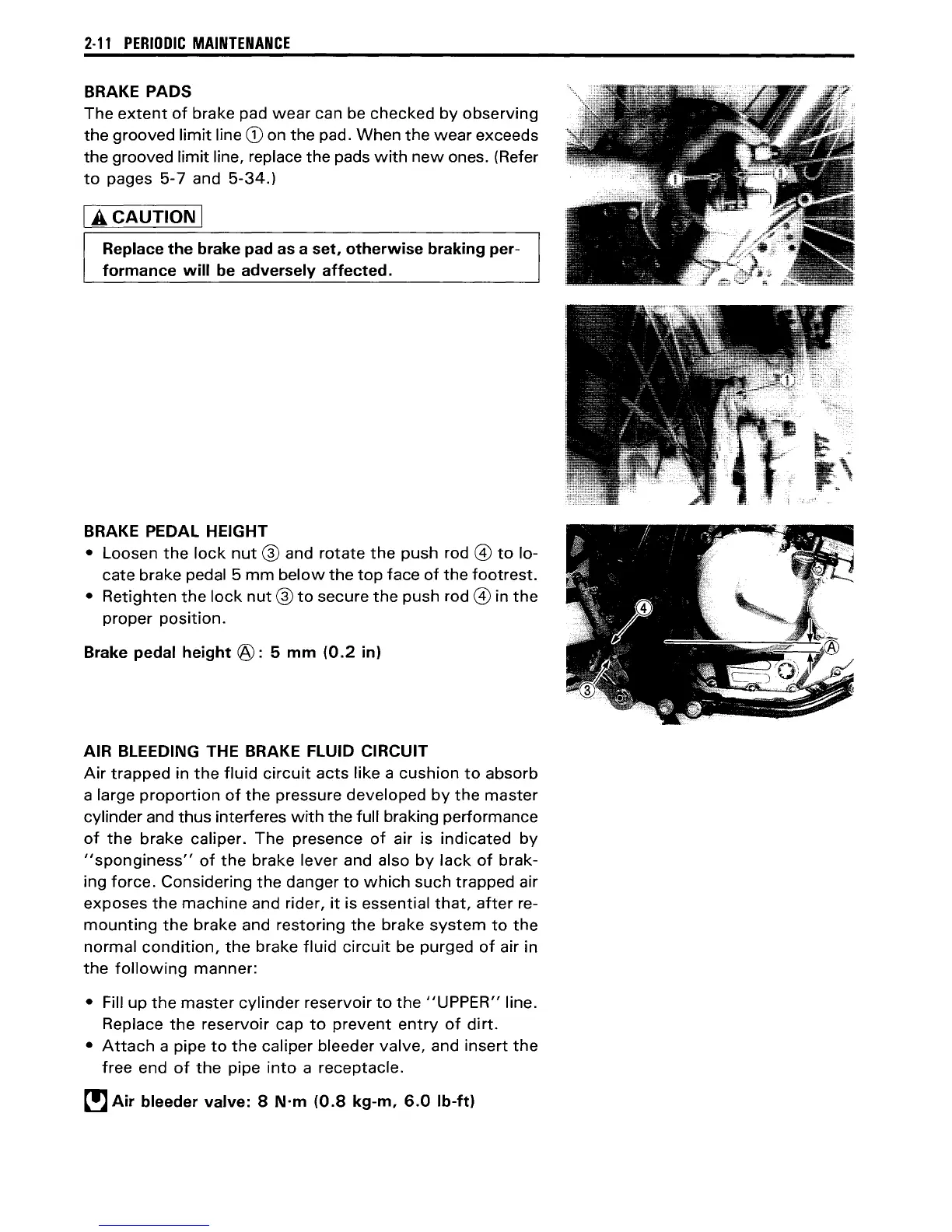
BRAKE PADS
The
extent
of
brake pad
wear
can be checked
by
observing
the
grooved
limit
line
G)
on
the
pad.
When
the
wear
exceeds
the
grooved limit line, replace
the
pads
with
new
ones. (Refer
to
pages
5-7
and
5-34.)
I A CAUTION I
Replace
the
brake pad as a
set,
otherwise
braking
per-
formance
will
be
adversely
affected.
BRAKE PEDAL HEIGHT
Loosen
the
lock
nut
@ and
rotate
the
push rod @
to
lo-
cate brake pedal 5
mm
below
the
top
face
of
the
footrest.
Retighten
the
lock
nut
@
to
secure
the
push rod @ in
the
proper
position.
Brake pedal
height
@:
5
mm
(0.2
in)
AIR BLEEDING THE BRAKE FLUID CIRCUIT
Air
trapped
in
the
fluid
circuit
acts
like a cushion
to
absorb
a
large
proportion
of
the
pressure developed
by
the
master
cylinder and
thus
interferes
with
the
full braking performance
of
the
brake caliper. The presence
of
air is
indicated
by
"sponginess"
of
the
brake lever and also
by
lack
of
brak-
ing force. Considering
the
danger
to
which
such
trapped
air
exposes
the
machine
and rider,
it
is essential
that,
after
re-
mounting
the
brake and
restoring
the
brake
system
to
the
normal
condition,
the
brake
fluid
circuit
be purged
of
air in
the
following
manner:
Fill up
the
master
cylinder
reservoir
to
the
"UPPER"
line.
Replace
the
reservoir cap
to
prevent
entry
of
dirt.
Attach
a pipe
to
the
caliper bleeder valve, and
insert
the
free end
of
the
pipe
into
a receptacle.
t!J
Air
bleeder valve: 8
N-m
(0.8
kg-m,
6.0
Ib-ft)

Table of Contents

Other manuals for Suzuki DR650SE

Related product manuals