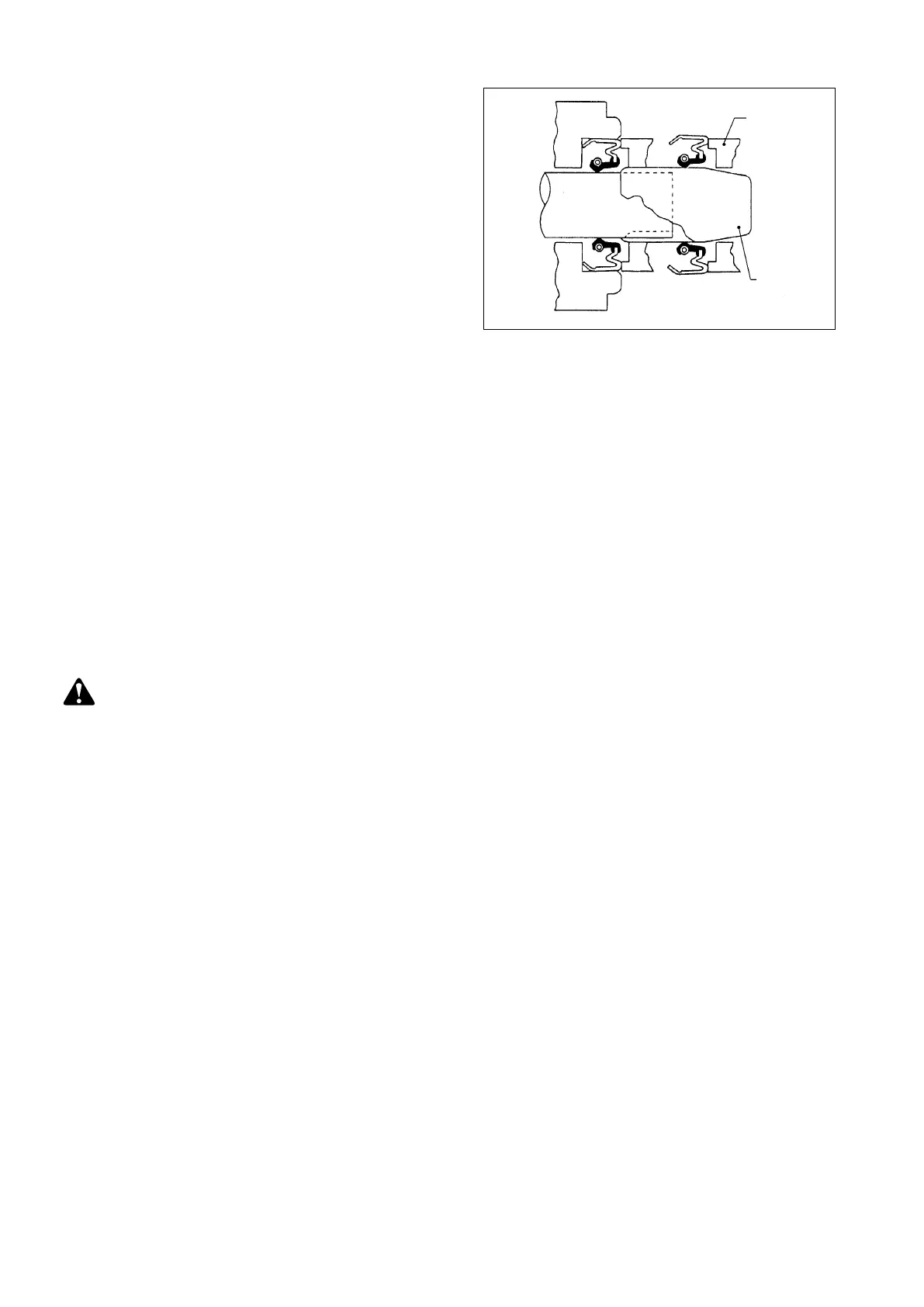
③ When installing an oil seal onto a shaft, apply
lubricating oil or grease to its seal lip and the
mounting surface of the shaft. For a double-lip type,
ll grease by 1/3 to 1/2 of the space between the lips.
When inserting an oil seal into a case, use care to
damage the seal lip. It is good practice to use a
suitable conical sleeve.
4. Using LOCTITE
(1) Procedure for using LOCTITE
① Clean or degrease the surface of parts you are going to apply LOCTITE, using trichloroethylene, acetone,
ether or alkaline solution.
② Blow dry them with compressed air or allow to air dry at room temperature sufciently.
③ Apply specied LOCTITE.
(2) Removing parts
When removing parts which were installed with the application of LOCTITE, use tools such as a spanner,
wrench, and pulley remover.
If you fear that a part may break due to the effect of LOCTITE if forcibly removed, heat the part to 200 to
250°C with a soldering iron or gas burner.
Remember that parts are very hot after heating. Use caution not to get burnt when removing them.
(3) Reinstalling parts
① When destroyed, LOCTITE remains as white powder on the threads of bolts.
You can apply a new coat of
LOCTITE again over their surface.
Note: For example, if a bolt turns slightly due to bolt torque checking, remove the bolt and apply LOCTITE
again and reinstall.
② If LOCTITE is used for the surface of a ange, it is necessary to remove hardened LOCTITE with a wire
brush when reinstalling the ange.
Fig. 1.4 Installing Oil Seal
SLEEVE
JIG


 To Next Page