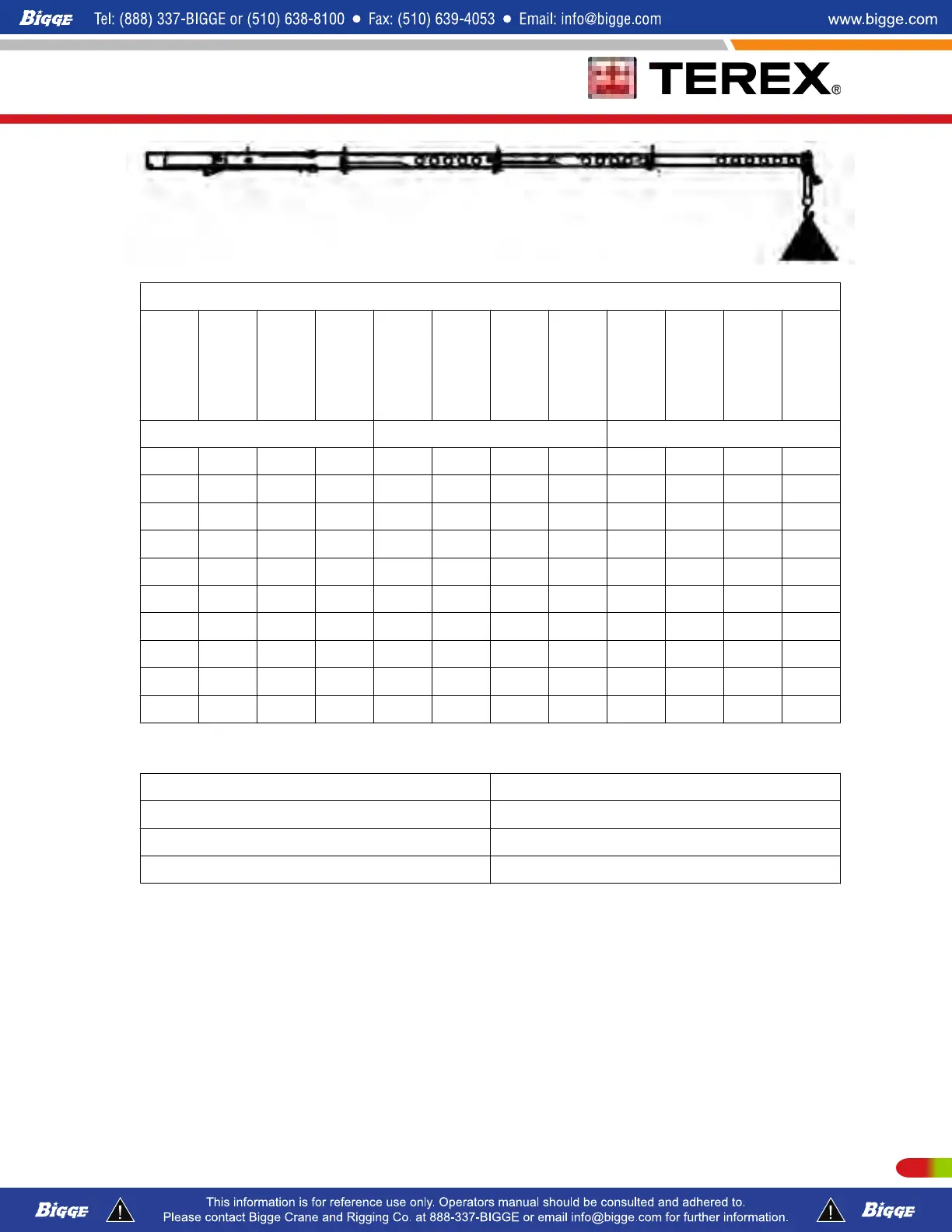
Rated Load On Outriggers
Load
Radiu
s (FT)
Loade
d
Boom
Angle
(DEG)
Over
Rear
(LB)
360° Load
Radiu
s (FT)
Loade
d
Boom
Angle
(DEG)
Over
Rear
(LB)
360° Load
Radiu
s (FT)
Loade
d
Boom
Angle
(DEG)
Over
Rear
(LB)
360°
Boom Length 30 FT Boom Length 39 FT Boom Length 50 FT
10.0 62.5 40000 40000 10.0 69.1 40000 40000
12.0 58.1 40000 40000 12.0 65.9 40000 40000 12.0 71.4 40000 40000
15.0 51.0 39100 39100 15.0 60.9 39900 39900 15.0 67.7 37700 37700
20.0 37.0 27500 27500 20.0 51.9 28300 28300 20.0 61.4 28900 28900
25.0 13.2 19800 19800 25.0 41.7 21300 21000 25.0 54.5 21900 21500
25.6 .0 18600 18600 30.0 28.5 16600 14500 30.0 47.0 17200 15100
34.3 .0 13500 10700 35.0 38.4 13900 11200
40.0 27.6 11200 8400
45.0 7.6 8900 6400
45.3 .0 8700 8200
Example:
Hook Block 660 lbs.
Slings 215 lbs.
Object Lifted 18,700 lbs.
Lifted Load = 19,575 lbs.
On Outriggers Using Main Boom
To determine the lift capacity when lifting off the main boom with the outriggers set, use the
following procedure:
1. Determine the weight of the load to be lifted.
2.
Determine the weight of slings, rigging hardware and hook block.
3. Calculate weight of lifted load.
4. Determine load radius, boom angle, and boom length.
5. Determine which load chart to use for your lift. Individual load charts exist for the
following lift configurations:
199P/N 12261-683 REVISED: January 2015



 To Next Page