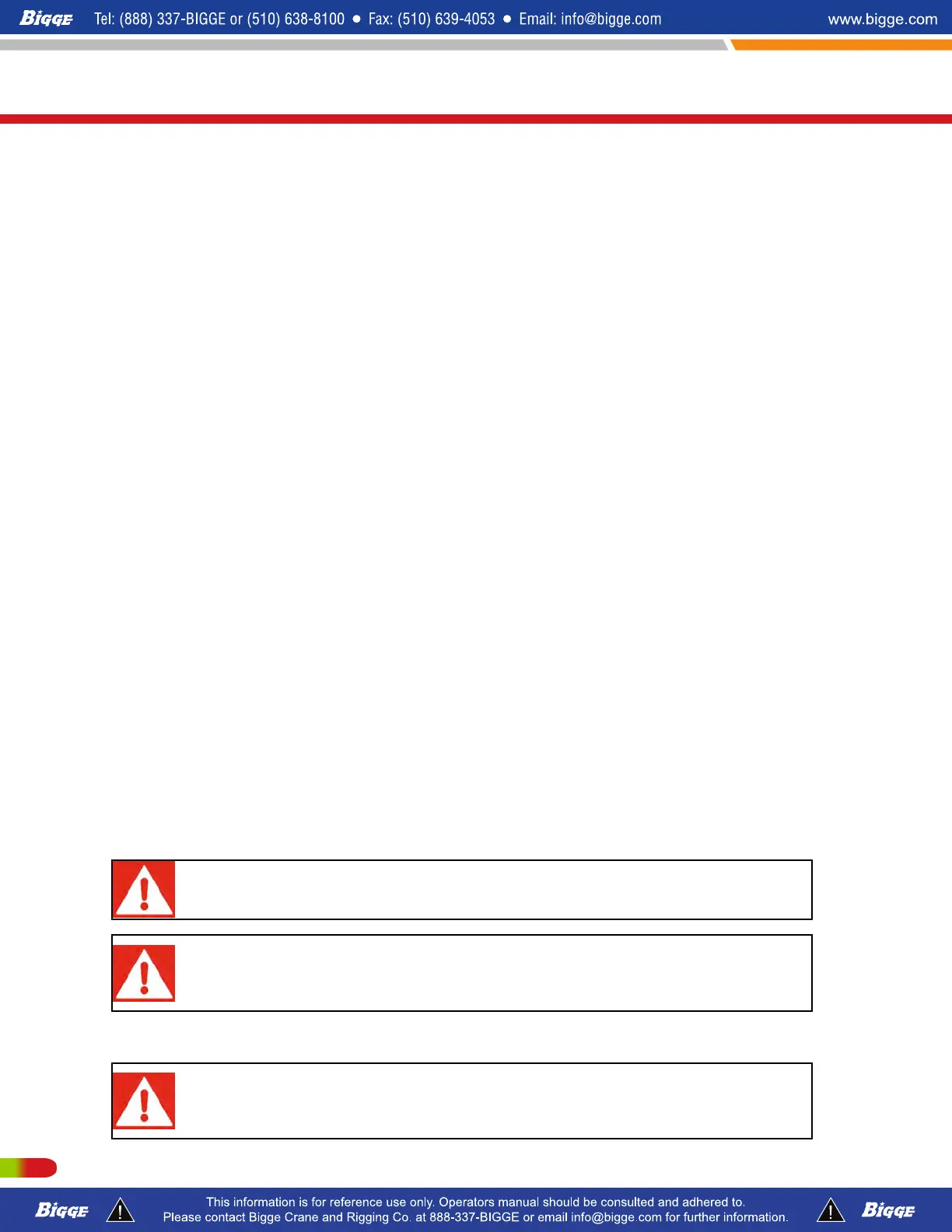
"On-Tires" Lift
Listed below are special precautions for “On Tires” lifts.
All static crane load ratings are based on nonuse of the travel function while handling loads.
However, cranes may be utilized for pick and carry operations. Traveling with suspended
loads involves so many variables such as ground conditions, boom length, momentum in
starting and stopping, etc., that it is impossible to devise a single standard rating procedure
with any assurance of safety. For such operations the user must evaluate prevailing
conditions and determine safe practices, exercising precautions, such as the following:
1. The boom shall be carried straight over the rear of the crane.
2. Travel speed reduced to suit conditions.
3. Maintain specified tire pressures.
4. Avoid sudden starts and stops.
5. Provide tag or restraint lines to snub swinging of the load.
6. Keep the load as close to ground as possible.
7. Set the swing brake and swing lock.
8. Travel must be on a smooth level surface that is capable of supporting the weight of
the loaded crane. The travel surface must also be free of holes or debris that can
cause crane instability.
9. If equipped with rear air suspension, the rear air should be “dumped” before lifting or
travelling with a load on tires.
These precautions are necessary to prevent a swinging load, which can cause a machine
tip over.
Any variation from the above conditions will require the operator to consider the prevailing
conditions and reduce the lift capacities accordingly.
These precautions are necessary to prevent a swinging load, which can cause a machine
tip over.
Any variation from the above conditions will require the operator to consider the
prevailing conditions and reduce the lift capacities accordingly.
Always carry the load as near the ground as possible with the minimum boom
length necessary to carry the load, and straight over the rear with the swing brake
locked.
Travel over uneven terrain with excessive boom length can result in instability.
Insufficient tire pressure reduces the “ON TIRES” capacity. Attempts to pick
rated capacity without properly inflated tires may cause crane to tip and/ or result
in damage to tires and rims.
T300-1_T500-1_T780
Operating Instructions
202 P/N 12261-683
REVISED: January 2015



 To Next Page