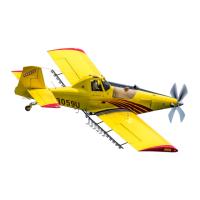
THRUSH AIRCRAFT, INC – MODEL S2R-G10
AIRCRAFT MAINTENANCE MANUAL
6-13
As a general rule, replace components
with holes that are out of round by
0.005” or more. Replacement of the
leaf spring forward attach P/N
NAS6207-38D bolt (inspect every 100
hours) with a larger diameter is not
approved. The leaf spring may not be
“drilled out” for a larger bolt.
D. Inspect main spring leaf for corrosion
and cracks. Check aircraft
maintenance records to be sure spring
leaf P/N 5079-1 has not exceeded its
five thousand (5,000) flight hour life
limit. Replace leaf spring as needed.
E. Inspect spindle housing assembly
welds for cracks.
F. Inspect spindle housing assembly for
cracks and corrosion.
G. Inspect lock pin and upper and lower
lock plates for wear, corrosion, cracks,
and proper operation.
H. Inspect centering springs for corrosion,
wear at ends, and for correct
operation.
I. Inspect lock pin flexible cable and
spring for corrosion and correct
operation.
J. Inspect P/N95207-1 Acetal (Delrin®)
lower support bracket spacer for wear
and cracks.
K. Inspect upper and lower leaf spring
support brackets, and attachment
hardware for wear, corrosion, and
cracks. Ensure that the leaf spring
support blocks grips the leaf spring
tightly to prevent leaf spring movement
fwd. and aft. Ensure flexible sealant
around contact edges of support
blocks, lower support block spacer and
leaf spring is intact to prevent
collection of potential corrosive
material in this area. Lubricate 2 ea.
Trunnion Zerk (grease) fittings with
MIL-G-81322 (Aeroshell 22)
L. Repair of the tail landing gear is limited
to replacement of component parts
such as bearings & bushings,
smoothing out minor nicks and
scratches and repainting chipped or
peeled paint.
TAIL LANDING GEAR INSTALLATION
Ensure that trunnion is straight down (6
O’clock position) and that leaf spring
support blocks grips the leaf spring tightly
to prevent movement fwd. or aft. (Add or
subtract P/N 90056-26 washers/spacers
(.063”) between upper and lower support
blocks to achieve a tight grip of leaf spring
after bolts are properly torqued.) All bolts
shanks and bolt holes are to be coated
with Snap-on™ General Purpose Anti-
seize lubricant or equivalent before
installation. Lubricate all bearings,
bushings, and Zerk (grease) fittings with
MIL-G-81322 (Aeroshell 22) grease.
Torque all hardware in accordance with
TORQUE CHART (figure 2-7, Section 2)
with the exception of the top spindle
castellated nut and wheel/tire axle
castellated nut, which should be torqued
as follows:
A. For spindle castellated nut: While
manually rotating spindle, torque
spindle castellated nut to 20 inch-
pounds, continue rotating spindle and
back off to zero inch-pounds. While
manually rotating spindle, torque nut to
10 inch pounds. If not in locking
position, advance nut to next position,
not to exceed 30º, and install cotter pin.
Bend ends of cotter pin around spindle
castellated nut. Note: Spindle must
rotate freely without perceptible play.
B. For tail wheel axle castellated nut:
While manually rotating wheel/tire,
torque axle castellated nut to 80 inch-
pounds, continue rotating wheel and
back off to zero inch-pounds. While
manually rotating wheel/tire, torque to
30 to 40-inch pounds. Rotate axle
castellated nut (clockwise or
counterclockwise) to nearest slot and
cotter pin hole, and insert cotter pin.
Bend ends of cotter pin around axle
nut. Note: Wheel/tire must rotate freely
without perceptible play.
Effective: 03/26/2010 Page


 To Next Page