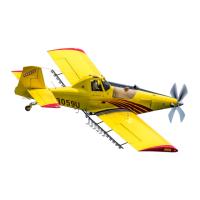
THRUSH AIRCRAFT, INC – MODEL S2R-G10
AIRCRAFT MAINTENANCE MANUAL
TURN COORDINATOR
The turn coordinator, installed in the
center of the upper instrument panel, is
a curved, fluid-filled tube containing a
ball. The gravitational and centrifugal
forces position the ball within the tube to
indicate a coordinated turn. A correctly
coordinated turn is indicated by a
centered ball, no matter what the bank
angle. An off center ball indicates that
additional rudder is needed on the side
the ball is off to.
POWER PLANT INSTRUMENTS
Ref. Figures 8-2 & 8-3 and Table 8-3
This group consists of the oil
temperature, oil pressure, fuel pressure,
fuel quantity and manifold pressure
gauges, as well as the engine
tachometer. See Table 8-3 for
instrument markings. See Section 5 for
more thorough description of fuel
quantity system.
OIL TEMPERATURE SYSTEM
The oil temperature indicating system is
electrically operated by the aircraft
electrical system and therefore only
works when the master switch is on.
The oil temperature transducer is
installed in the oil stream returning to
the engine from the oil cooler. The
transducer varies voltage to the
indicator in proportion to the oil
temperature, and the indicator needle
movement is proportional to the voltage.
Oil temperature is an indicator of the
condition of the oil cooling system and
the internal health of the engine. If the
oil cooling system is operating properly,
a high oil temperature could indicate
such engine problems as impending
bearing failure
Before assuming high oil temperature is
an indication of engine problems,
always make sure the oil cooling system
is working properly.
OIL PRESSURE SYSTEM
The oil pressure indicator works on the
Bourdon Tube principle whereby a semi-
circular hollow tube unbends in proportion
to internal pressure. This unbending
motion drives the pressure indicator needle.
The oil pressure system thus needs no
electricity, but must be connected to the oil
pressure sensor port on the aft side of the
engine gear case. A restrictor fitting is
installed between the gear case outlet fitting
and the hose to the oil pressure gauge. To
operate properly, the oil line between the
engine and instrument must be free of air.
Oil pressure is an indicator of how well oil is
being supplied to the internal components
of the engine. The desirable pressure is a
range because the pressure is influenced
by oil viscosity, which is in turn influenced
by oil type and the temperature it is
operating at.
Oil pressure higher than this range is not a
“more is better” situation, as it may be
caused by blockages in the oil distribution
system. Normally, however, high oil
pressure is experienced right after start-up
on a cold day, when the oil is still thick. It is
important to allow the oil to warm up to the
operating range before demanding power
from the engine. Always use the grade and
type of oil recommended by the engine
manufacturer, based on engine usage and
weather conditions.
Low oil pressure is bad news anytime, as it
indicates that the engine is not getting
enough lubrication. Oil viscosity decreases
as oil temperature increases, so a faulty oil
cooling system or internal engine problems
causing high oil temperature may be at
fault. Low oil pressure when oil
temperature is normal or low could indicate
a bad oil pump or the wrong grade of oil.
FUEL PRESSURE SYSTEM.
The fuel pressure gauge, like the oil
pressure gauge, operates off of the
Effective: 03/26/2010 Page 8-7


 To Next Page