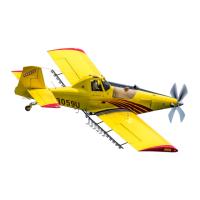
THRUSH AIRCRAFT, INC – MODEL S2R G10
AIRCRAFT MAINTENANCE MANUAL
B. Clean the general area of the leak
thoroughly. Better to clean too large of
an area than too small. If the source of
the leak is known exactly, seal it with B
type sealer. Apply an even coat of A
type sealant over the leak repair plus 3”
around it with a stiff clean brush.
C. If only the general area of the leak is
known, a larger area should be cleaned
(at least 12” past wherever the leak is
suspected) and the area coated with
type A sealant.
D. Allow the sealer to dry overnight.
E. After drying, the sealer should be
checked for air bubbles or thin spots.
Additional sealer should be applied
where necessary.
F. Reinstall the cover plates on wing
upper surface.
RESEALING AFTER COMPLETE SKIN
REMOVAL
To reseal the fuel tanks after removing or
repairing the wing skin, proceed as follows:
A. Prior to installing the wing tank skin,
vacuum tank area thoroughly to
remove all particles of dried sealant,
dirt or other foreign matter. Allow the
sealant to cure for 16 hours or more.
B. The entire tank interior should be
cleaned to remove fuel residue. All
surfaces that will receive sealant shall
be cleaned again and etched.
C. Apply type B sealant to all areas of
contact between the skin and ribs,
spars, intercostals and other skins.
D. Wet rivet the wing tank skin in place
Smooth out sealant squeezed out to
make fillet seals at all junctions.
E. Coat the entire replaced skin and all
supporting structure plus a 3” band
around it with type A sealant.
F. Reseal cover plates and fuel quantity
transmitter mounting with fuel proof
sealer.
5-11
G. To prevent water and chemical entry
into wing and empennage skin joints
and edges, fillet seal them by applying
a small bead of fuel proof sealant to all
skin edges, joints, and overlaps. The
fillets can be painted after sealer has
dried.
H. Pressure check fuel tank per the
following instructions.
FUEL TANK PRESSURE CHECK
REQUIRED EQUIPMENT
A. Pneumatic shut-off valve with an
operator that requires multiple turns
to open. This is so that pressure can
be applied gradually.
B. Manometer board per figure 5-5. (can
be locally fabricated).
C. Suitable flexible hose from shut-off
valve to wing fuel tank/system outlet.
D. Suitable flexible hose from wing fuel
tank vent to manometer board.
E. Worm clamps for attaching hoses to
wing fuel tank outlet and wing fuel
tank vent.
F. Suitable leak detection fluid and
applicator.
FUEL TANK SET-UP
When a wing fuel tank is being pressure
tested, one of the fuel outlets must be
capped, while the other is left open.
Prepare both outlet line and the fuel tank
vent line for connection to the manometer
board.
Ensure that all access hole covers are
installed properly, drain plugs are tight, and
the fuel filler cap is closed tightly.
PRESSURE CHECK SET-UP
Reference Figure 5-5, Manometer Board.
Enough colored water should be in the 1”
tube to extend beyond the curve slightly.
With no pressure on the 1” tube, align the
bottom of the manometer scale (the zero)
with the top of the colored water in the
manometer.
Plug shop air into the shut-off valve with
the shut-off valve closed. Connect the
Effective: 3/26/2010 Page


 To Next Page