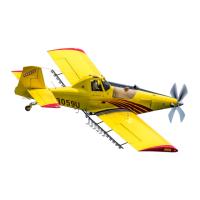
THRUSH AIRCRAFT INC – MODEL S2R G10
AIRCRAFT MAINTENANCE MANUAL
FUEL SYSTEM
GENERAL DESCRIPTION
Ref. Figure 5-1, 5-2 & 5-3
A 228 U.S. gallon useable fuel supply is
available for the Thrush G10. In each
wing, fuel is contained inside integral wing
tanks (wet wing fuel tanks) just outboard of
the fuselage. The left wing and right wing
fuel tanks are interconnected through a 4.5
U.S. gallon header tank that is located in
the fuselage. The fuel supply lines to the
engine are routed from the header tank
outlet finger screen through a fuel shutoff
(on/off) valve to an electric powered
auxiliary fuel pump. The auxiliary fuel
pump discharge is then routed through a
25-micron main fuel filter to the engine fuel
control unit (FCU).
The fuel tank vent system is designed to
keep fuel spillage to a minimum. The fuel
tanks are vented through tubing connected
at both the inboard and outboard ends of
the individual fuel tanks to the centrally
located vent system in the fuselage. Ram
air enters a vent scoop, on the fuselage
under the left wing and pressurizes the
vent system in order to maintain positive
pressure in the fuel tanks. The vent
system is provided with two quick drains,
located on the fuselage side skins under
each wing to drain any fuel or
condensation that might have gotten in the
tank’s outboard vent lines.
5-2
The fuel quantity gauge is located on the
lower left instrument panel. The fuel
quantity indicating system consists of two
transmitters, one indicator gauge, and a
L/H or R/H tank fuel quantity selector
switch. A transmitter, installed in each
wing tank, transmits an electrical signal to
the single fuel quantity indicator. The
indicator reads either the left or right fuel
tank individually, as chosen with the tank
selector switch, adjacent to the fuel
quantity indicator gauge on the instrument
panel.
Because of the geometry of the fuel tanks
and the fuel quantity transmitters, the fuel
quantity indicator needle reaches its upper
limit when the fuel tank contains 82 gallons
of useable fuel. Another 7.5 gallons of
useable fuel is in the tank when it is topped
off. Until the fuel level in the tank falls
below 82 gallons, one cannot depend on
the fuel quantity indicator to indicate
accurately how much fuel remains in the
tank. This is what is meant by the placard
on the indicator that says “FUEL ABOVE
82 GAL IS UNGAGEABLE”.
The two fuel tanks are serviced through
filler ports located on the top of both wings.
The filler ports incorporate security chains
to prevent the loss of the fuel caps.
Service the aircraft from refueling facilities
that utilize proper ground handling
equipment and filter systems to remove
impurities and water accumulations from
the bulk fuel. If filtering facilities are not
available, filter the fuel through a quality
high-grade chamois. Fuel tanks should be
serviced after the last flight of each day to
reduce condensation and allow any
entrapped water accumulations to settle to
the fuel system drains. Prior to the next
flight, fuel should be drained from each
wing tank drain, the header tank drain, and
the firewall fuel filter, until all signs of water
are gone.
MAINTENANCE PRECAUTIONS
The establishment of safe maintenance
procedures is necessary to ensure safety
of personnel and prevent damage to the
aircraft when performing fuel system
maintenance. The principle precautions
that should be enforced are as follows:
A. Perform fuel system maintenance in an
approved work area.
B. Ground aircraft and maintenance
stands to a common ground. Ground
points must not be painted.
C. Remove external power sources and
disconnect batteries.
Page Effective: 03/26/2010


 To Next Page