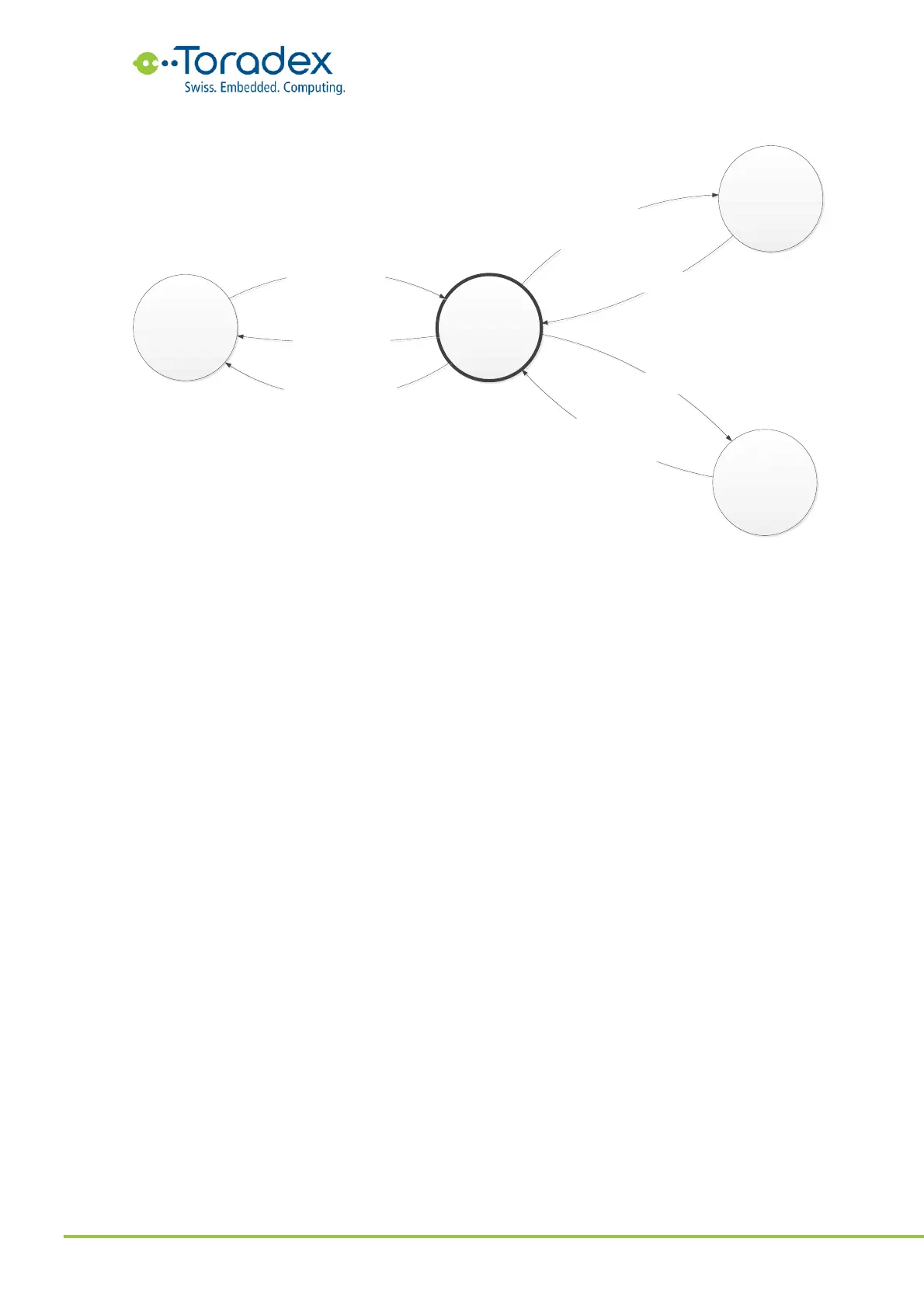
3.4.3.2 System Power States
Figure 64: System Power States and Transitions
Since the main voltage VCC is always available on the module, the state “No VCC” does not exist
in this approach. The carrier board ignores the CTRL_FORCE_OFF_MOCI# signals which means
the module remains in the “Module OFF” state. The power consumption in this state is small
enough for keeping the VCC rail permanently on for several months with a regular Li-ion battery.
It should be noted that the module is directly turning on when the Li-ion battery is attached for the
first-time during production. While the ramping up of the module voltages cannot be prevented,
the booting of the module can be prevented by keeping the CTRL_RESET_MICO# low. This allows
to shut down the module by long pressing CTRL_PWR_BTN_MICO# without actually booting the
module.
3.4.3.3 Reference Schematics
TBA
3.5 Backfeeding
3.5.1 Introduction
Backfeeding is sometimes also called backflow. Backfeeding is an unintentional and irregular flow
of current mainly over the signal path. It can happen if interfaces are crossing different power
domains. Backfeeding can happen between circuit blocks powered by or switched by different
power rails (power domains) and thus transitioning through different power states over time. A
domain that is still powered can feed another power domain. This can lead to residual voltages on
a power rail that is supposed to be turned off.
The most obvious consequences of backfeeding are increased power consumption, unexpected
behaviors, failing power-on resets, and in the worst-case, damages of interfaces. This section
discusses why backfeeding occurs, how it can be identified, and potential preventions of
backfeeding in a Verdin carrier board design.


 To Next Page