Interfaces that are prone to backfeed are UART, RS232, HDMI, and I2C. Therefore, special
attention is required to these interfaces when designing a carrier board for the Verdin module.
3.5.2 What is Backfeeding
Backfeeding is sometimes also called backflow. To understand what backfeeding is, we need to
look at the internal circuit of an input pin. Most Verdin module pins (and also peripheral device
input pins) feature ESD protection diodes. These protection diodes provide basic protection for
electrostatic discharge. Depending on the SoC and peripheral devices, the pins are typically only
protected up to 1kV (Human Body Model) or 250V (Charged-Device Model). This means additional
ESD protection is still needed for signals that are exposed to the real world. The basic ESD
protection is usually accomplished with two (Schottky) diodes. One diode is between the pin and
the ground, and a second between the pin and the power rail of the I/O block (IO rail). These
diodes are the reason why for a lot of IO pins, the absolute maximum voltage is specified as
VDD+0.3V.
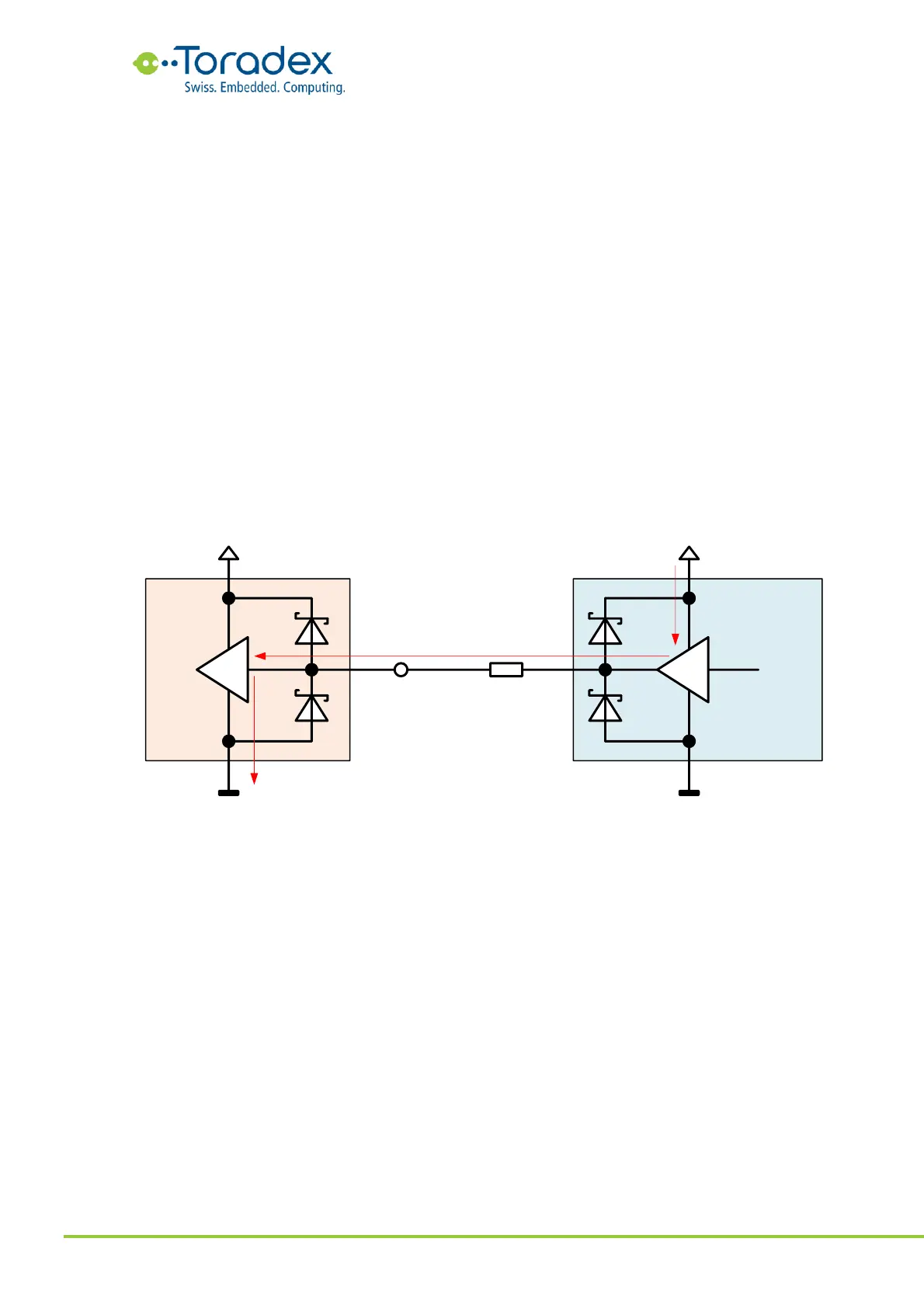
Figure 65 shows a typical low-speed SoC input pin with ESD protection diodes. If the IO rail and
the peripheral rail are turned on, these ESD diodes are not conducting. The diodes can basically be
ignored. There is a small current flowing from the peripheral output to the input buffer of the SoC.
This is not backfeeding. This is a regular signal current.
Figure 65: SoC input pin with ESD protection, both power rails on
But what happens if the on-module IO rail is turned off while the peripheral rail is still on and the
peripheral signal is set to high? In this situation, there is a non-marginal current from the output
buffer of the peripheral interface into the SoC input pin. Since the IO rail is turned off, the upper
ESD protection diode of the input pin becomes forward-biased. The current flows through the
diode to the IO rail pin. In other words, the IO rail gets fed through the IO pin. This is called
backfeeding. Figure 66 shows a backfeeding path and possible voltage values. Depending on the
situation, the backfeeding can reach several milliamperes. Therefore, the output buffer of the
peripheral signal already has some voltage drop. In the example, the drop in the buffer is 0.2V.
This means the output voltage is only 1.6V. Some voltage is lost in the series resistor. Therefore,
only 1.3V arrives at the SoC input pin. There is a further voltage drop in the ESD protection diode.
0.3V is a typical value for a Schottky type diode. In this example, the backfeeding path lifts the IO
rail to 1V, even though the power supply is turned off. Of course, the actual resulting IO voltage is
heavily dependent on the load on the IO rail and the backfeeding path, and the number of pins
that are backfeeding.


 To Next Page