7-1
COMMANDER / EMBASSY
7 TRAVELLING
The motorhome has been designed to provide the
driver and passengers maximum comfort and conven-
ience while travelling safely from one place to another.
It is the responsibility of the owner/operator/driver to
review the safety section at the front of this manual
and the chassis manual before travelling in the mo-
torhome.
7.1 PREPARATION
Review the chassis manual and previous sections of
this manual before starting or driving the vehicle.
7.2 BAGGAGE LOADING
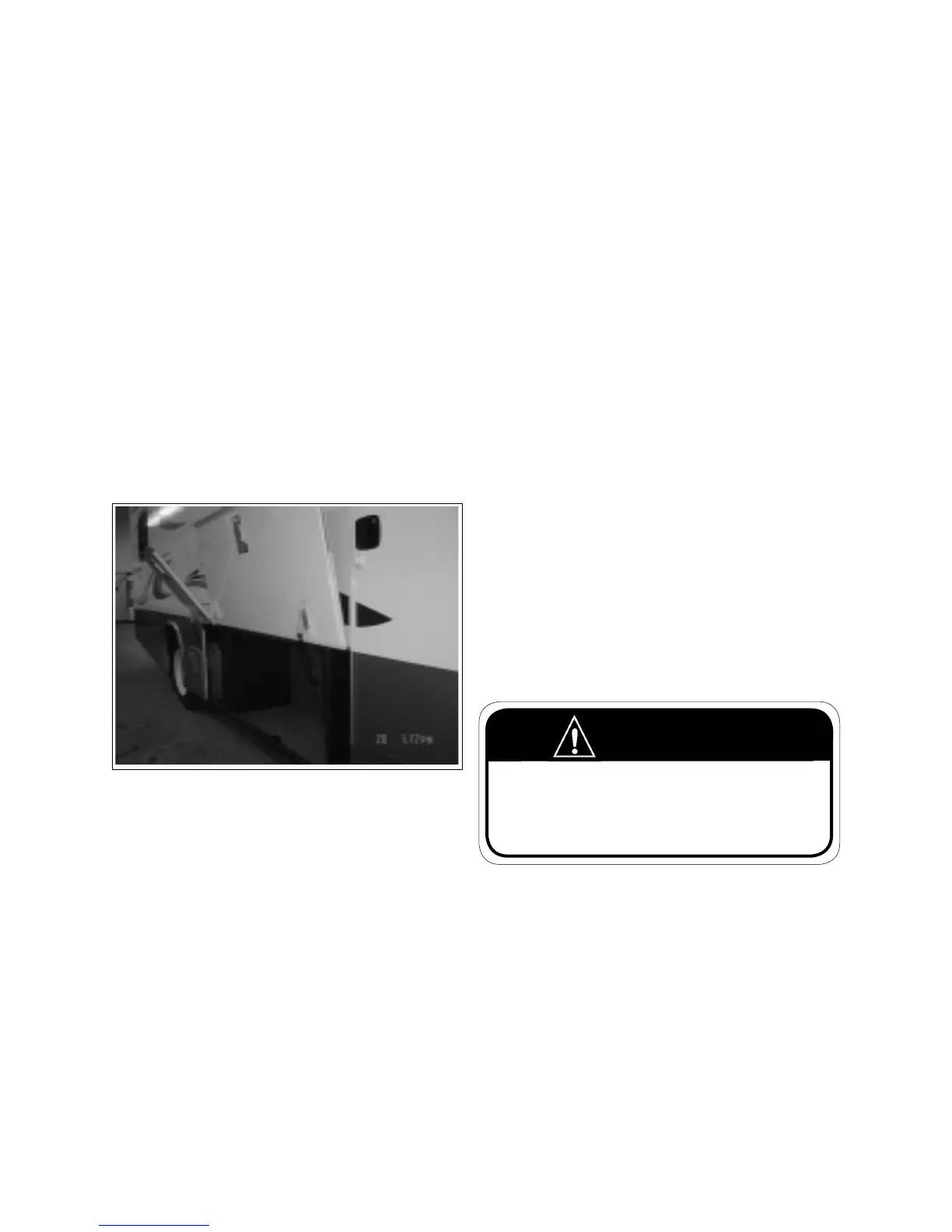
Your motorhome is equipped with exterior compart-
ments for carrying or storing baggage or luggage. Do not
exceed baggage area loading or weight capacity and do
not exceed vehicle GVWR. Always secure your cargo and
keep the compartment locked when traveling.
7.3 VEHICLE WEIGHT LOADED
Fig. 7-1 BAGGAGE COMPARTMENTS
When loading the motorhome, make sure that the
Front or Rear Gross Axle Weight Rating (GAWR) or the
Gross Vehicle Weight Rating (GVWR) and the Gross
Combined Weight Rating (GCWR) are not exceeded.
Check your Vehicle Certication Label for weights. If
in doubt, take your motorhome to a weigh scale and
check the front axle, rear axle and total vehicle weight
on a scale.
Distribute the weight in the motorhome evenly from
side to side to maintain maximum vehicle stability.
IMPORTANT
It is recommended that all holding tanks be emptied
before travelling to avoid unnecessary weight.
CAUTION
The loaded weight of the vehicle including passengers,
optional equipment, water, fuel, luggage and all other
cargo must not exceed the GVWR or GAWR indicated on
the Vehicle Certication Label.
7.4
FRONT AXLE TIRE ALIGNMENT
The front-end tire/wheel alignment was done at the
factory prior to delivery based on the vehicle being empty
and on the weight distribution at that time.
It is recommended that the front end be aligned once
you have established a loading pattern according to your
needs. After an initial adjustment, it is a good idea to have
the front suspension checked periodically and to check
tires regularly for abnormal wear.
7.5 MAXIMUM OCCUPANCY
The belted seating positions in your motorhome may be
dierent than the stated sleeping capacity. In the US this
is referred to as the Net Carrying Capacity (NCC) or the
Cargo Carrying Capacity (CCC) in Canada.
Triple E uses sleeping capacity as opposed to seating
capacity to determine the NCC or CCC. You may use all
the belted seating positions available in your motorhome
provided you stay within the GVWR listed on your Vehicle
Certication Label.
All occupants must be in seats equipped with lap or
shoulder harness seat belts and the seat belt fastened
before travelling. Small children should always be
placed in a certied child restraint system and secured
with a seat belt.
WARNING
7-1
COMMANDER / EMBASSY
7 TRAVELLING
The motorhome has been designed to provide the
driver and passengers maximum comfort and conven-
ience while travelling safely from one place to another.
It is the responsibility of the owner/operator/driver to
review the safety section at the front of this manual
and the chassis manual before travelling in the mo-
torhome.
7.1 PREPARATION
Review the chassis manual and previous sections of
this manual before starting or driving the vehicle.
7.2 BAGGAGE LOADING
Your motorhome is equipped with exterior compart-
ments for carrying or storing baggage or luggage. Do not
exceed baggage area loading or weight capacity and do
not exceed vehicle GVWR. Always secure your cargo and
keep the compartment locked when traveling.
7.3 VEHICLE WEIGHT LOADED
Fig. 7-1 BAGGAGE COMPARTMENTS
When loading the motorhome, make sure that the
Front or Rear Gross Axle Weight Rating (GAWR) or the
Gross Vehicle Weight Rating (GVWR) and the Gross
Combined Weight Rating (GCWR) are not exceeded.
Check your Vehicle Certication Label for weights. If
in doubt, take your motorhome to a weigh scale and
check the front axle, rear axle and total vehicle weight
on a scale.
Distribute the weight in the motorhome evenly from
side to side to maintain maximum vehicle stability.
IMPORTANT
It is recommended that all holding tanks be emptied
before travelling to avoid unnecessary weight.
CAUTION
The loaded weight of the vehicle including passengers,
optional equipment, water, fuel, luggage and all other
cargo must not exceed the GVWR or GAWR indicated on
the Vehicle Certication Label.
7.4
FRONT AXLE TIRE ALIGNMENT
The front-end tire/wheel alignment was done at the
factory prior to delivery based on the vehicle being empty
and on the weight distribution at that time.
It is recommended that the front end be aligned once
you have established a loading pattern according to your
needs. After an initial adjustment, it is a good idea to have
the front suspension checked periodically and to check
tires regularly for abnormal wear.
7.5 MAXIMUM OCCUPANCY
The belted seating positions in your motorhome may be
dierent than the stated sleeping capacity. In the US this
is referred to as the Net Carrying Capacity (NCC) or the
Cargo Carrying Capacity (CCC) in Canada.
Triple E uses sleeping capacity as opposed to seating
capacity to determine the NCC or CCC. You may use all
the belted seating positions available in your motorhome
provided you stay within the GVWR listed on your Vehicle
Certication Label.
All occupants must be in seats equipped with lap or
shoulder harness seat belts and the seat belt fastened
before travelling. Small children should always be
placed in a certied child restraint system and secured
with a seat belt.
WARNING



 To Next Page