10-1
10 ELECTRICAL SYSTEMS
Your Motorhome is equipped with two electrical
systems operating on separate voltages - a 12 Volt DC
System and a 120 Volt AC System.
The Motorhome's 12 Volt DC System draws its power
from the coach batteries while the chassis batteries
remain dedicated to engine starting and powering
chassis loads. An isolator solenoid is installed and
controlled so that when the chassis batteries are being
charged by the alternator, and certain conditions are
met the coach batteries will also be charged. Likewise,
when the coach batteries are being charged by a
converter or inverter, the isolator solenoid system will
connect the coach and chassis batteries together so
the chassis batteries are also charged.
There is a 12-volt Coach battery fuse block in or near
the 120-volt circuit breaker panel where all coach
battery loads are fused. In addition to the chassis
provided fuse centers, your coach has a Triple E
provided 12-volt chassis battery fuse block locatee in
the dash area. Most Triple E added loads to the chassis
battery are fused at this location.
The 120 Volt AC System is powered either by the
optional generator installed in your Motorhome or by
Shore power plugged into the appropriatly sized and
congured shore power receptacle. Individual branch
circuits are fused in the breaker panel and in the case
of an inverter, two more branch circuit breakers are
located on the inverter.
10.1 120 VOLT AC SYSTEM
When connected to an outside electrical utility such as
that provided by most campgrounds or when running
your 120 volt generator, the converter supplies 12V
power and also charges coach batteries. All equipment
that normally is powered through the battery system
will now get its power from the converter.
Some equipment, however, depends entirely on 120
volts from an outside connection or from the optional
120 volt generator.
These include:
1. Roof Air Conditioners
2. Refrigerator (when set to 120 volt)
3. Microwave Oven
4. Ice Maker
5. Central Vacuum
6. All 120 Volt Electrical Outlets
7. Energy Management System
10.1.1 EXTERNAL POWER CORD
(SHORE POWER)
The external utility power cord (also called “Shore
Power”) is stored in the compartment on the left
COMMANDER / EMBASSY
Commander
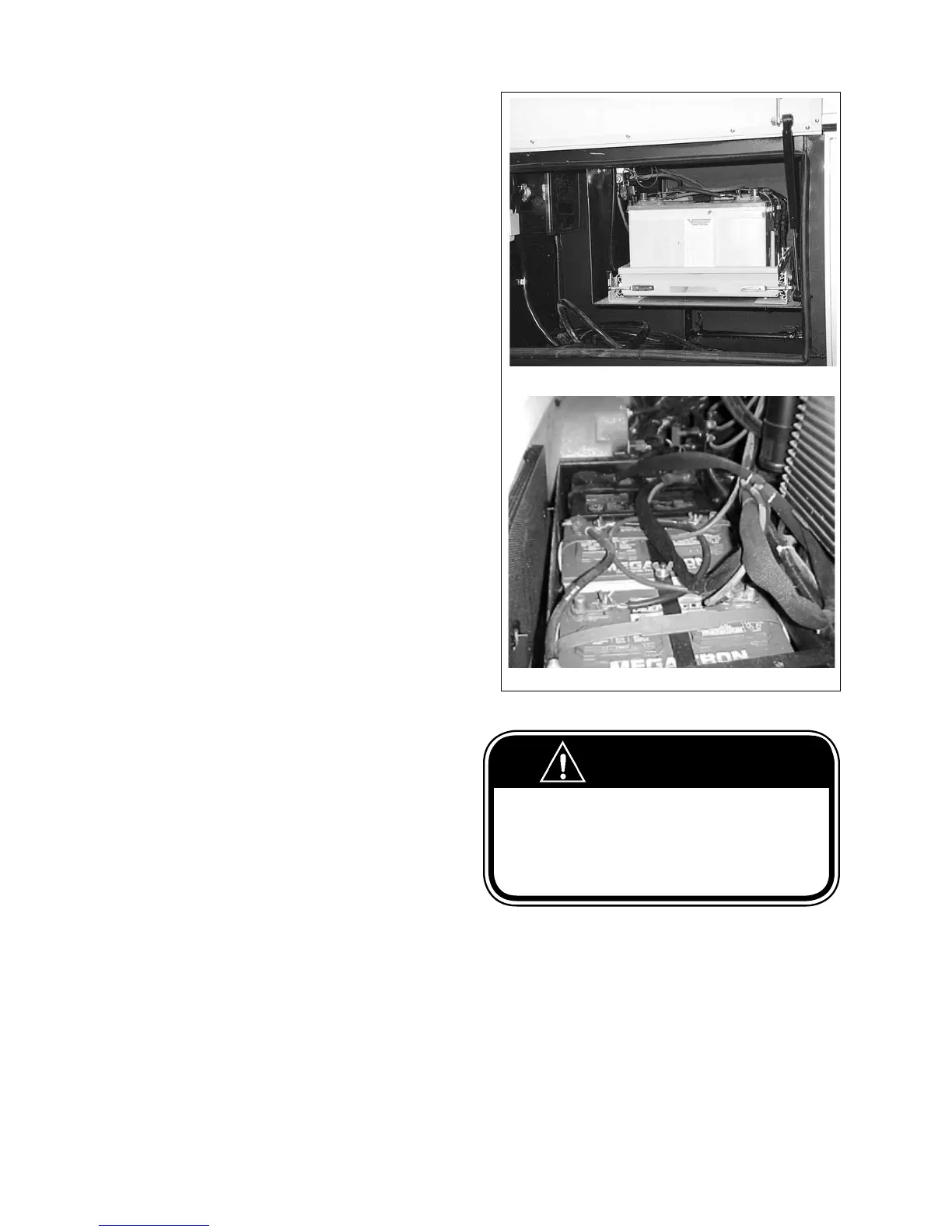
Fig. 10-1 COACH BATTERY LOCATION
Embassy
(driver's) side of the motorhome.
To connect your motorhome to an external power
source, pull the cord through the cord hatch and plug
it into the proper receptacle. Always ensure some slack
is present in the cable.
WARNING
Do not connect the external power cord until you have
checked with the owner/attendant of the campground
as to proper polarity and grounding.
Improper grounding or reverse polarity can cause com-
ponent failure, serious injury or death.
10-1
10 ELECTRICAL SYSTEMS
Your Motorhome is equipped with two electrical
systems operating on separate voltages - a 12 Volt DC
System and a 120 Volt AC System.
The Motorhome's 12 Volt DC System draws its power
from the coach batteries while the chassis batteries
remain dedicated to engine starting and powering
chassis loads. An isolator solenoid is installed and
controlled so that when the chassis batteries are being
charged by the alternator, and certain conditions are
met the coach batteries will also be charged. Likewise,
when the coach batteries are being charged by a
converter or inverter, the isolator solenoid system will
connect the coach and chassis batteries together so
the chassis batteries are also charged.
There is a 12-volt Coach battery fuse block in or near
the 120-volt circuit breaker panel where all coach
battery loads are fused. In addition to the chassis
provided fuse centers, your coach has a Triple E
provided 12-volt chassis battery fuse block locatee in
the dash area. Most Triple E added loads to the chassis
battery are fused at this location.
The 120 Volt AC System is powered either by the
optional generator installed in your Motorhome or by
Shore power plugged into the appropriatly sized and
congured shore power receptacle. Individual branch
circuits are fused in the breaker panel and in the case
of an inverter, two more branch circuit breakers are
located on the inverter.
10.1 120 VOLT AC SYSTEM
When connected to an outside electrical utility such as
that provided by most campgrounds or when running
your 120 volt generator, the converter supplies 12V
power and also charges coach batteries. All equipment
that normally is powered through the battery system
will now get its power from the converter.
Some equipment, however, depends entirely on 120
volts from an outside connection or from the optional
120 volt generator.
These include:
1. Roof Air Conditioners
2. Refrigerator (when set to 120 volt)
3. Microwave Oven
4. Ice Maker
5. Central Vacuum
6. All 120 Volt Electrical Outlets
7. Energy Management System
10.1.1 EXTERNAL POWER CORD
(SHORE POWER)
The external utility power cord (also called “Shore
Power”) is stored in the compartment on the left
COMMANDER / EMBASSY
Commander
Fig. 10-1 COACH BATTERY LOCATION
Embassy
(driver's) side of the motorhome.
To connect your motorhome to an external power
source, pull the cord through the cord hatch and plug
it into the proper receptacle. Always ensure some slack
is present in the cable.
WARNING
Do not connect the external power cord until you have
checked with the owner/attendant of the campground
as to proper polarity and grounding.
Improper grounding or reverse polarity can cause com-
ponent failure, serious injury or death.



 To Next Page