34
wallaceperimetersecurity.comPhone: 866.300.1110
EXTERNAL ENTRAPMENT SENSOR TYPES
External Entrapment Sensor Types
PHOTOELECTRIC EYE:
A photoelectric eye is used to detect physical objects in the gate travel path. If it is blocked during the
opening or closing moon of the gates, the gates will stop and reverse to the cycle start posion. If the gate
is at the open posion and the auto close mer is acvated, the gate will funcon as normally congured.
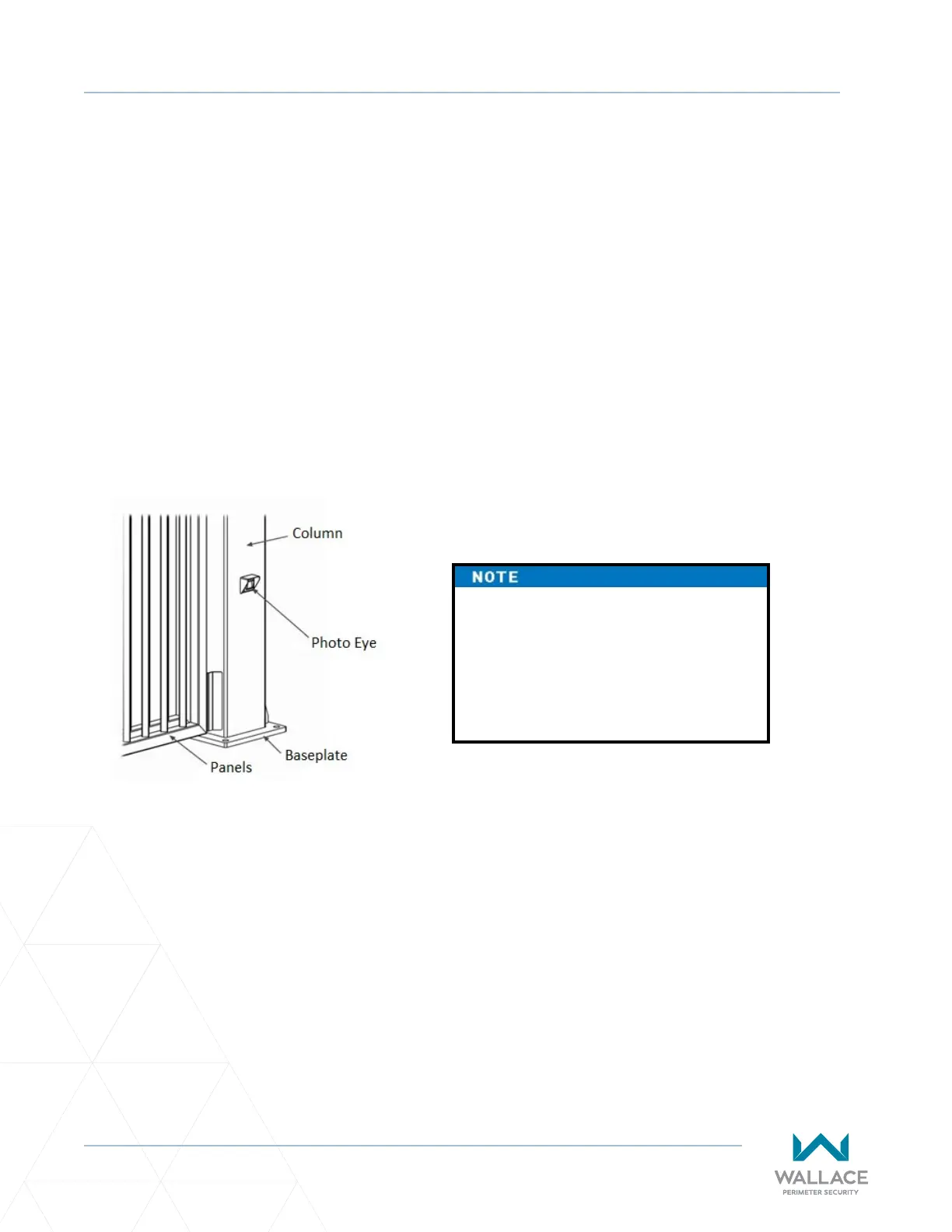
Photo eyes are mounted on the SpeedGate column. If there is a person situated in-between the columns,
the light beam of the photo eyes is interrupted and a safety input is acvated, prevenng the gate from
moving. The SpeedGate-designated height for boom-mounted photo eyes is 24” (61 cm) above grade
and, for the top pair (if included in the installaon), 60” (152cm) above grade. Photo eyes are commonly
mounted within 5” (13cm) of the gate panels in the closed posion.
Refer to “Table 3. Tripped External Entrapment Sensor Modes” on page 35 for a summary of photo eye
responses to obstrucon detecon.
EDGE SENSORS (OPTIONAL):
The ends of the outermost panel secons (where the risk of entrapment or obstrucon exists) include
a provision for ng contact-pressure-sensive gate edges for connecon to the control circuit. When
installed gate edges are pushed, they transmit a signal which interrupts the power and sends a signal to
the gate to stop and react in accordance with UL 325 regulaons. If the boom edge of the gate is situated
more than 6 inches (152 mm) above ground level at any point in its arc of travel, one or more contact
sensors must be located on the boom edge, as well.
If any gate edge encounters an obstrucon, the gate will stop and begin to reverse in less than 2 seconds.
Refer to Table 3 below.
Figure 3. Infrared Beam Photo Eye
The SpeedGate is shipped with one set
of through-beam type photo eyes.
If a higher safety level is required, the
SpeedGate can be equipped with two
sets of photo eyes.


 To Next Page