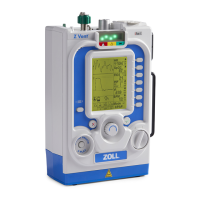
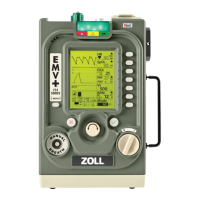
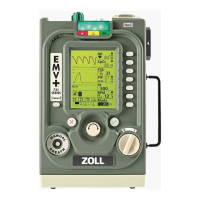
Device Overview & Architecture
2–8 www.zoll.com 906-0731-04-01 Rev. C
Functional Descriptions
Flow Manifold Assembly
The flow manifold assembly comprises of the O2 flow system, the mix manifold and the compressor connector.
Directly attached to the flow manifold are the Connector panel, O2 filter assembly, the gas outlet fitting, compressor
assembly and the Fresh Gas/Emergency Air Intake assembly. One of flow manifold's main purpose is to route and
mix, if needed, the 2 primary gas sources (oxygen and air) to the patient. The assembly also houses the pneumotach
components necessary to measure the two gas flows. Sensors (oxygen flow, oxygen pressure and compressor flow)
and the exhalation control valves are connected to the flow manifold via tubing.
Compressor Flow System
The compressor flow system includes the Fresh Gas/Emergency Air Intake assembly, Compressor assembly, flow
sensor, motor drive circuitry, diffuser and pneumotach. During compressor operation, room air (or a combination of
room air with low flow oxygen) is entrained and cleaned through a 2-stage filtering process in the Fresh Gas /
Emergency Air intake assembly. A sensor measures the incoming pressure to determine if any blockage is present.
The flow rate is controlled by adjusting the compressor motor speed using hardware on the SPM board. The air flow
is then diffused and measured using a pneumotach connected to a differential pressure transducer. A calibration
table is used to determine and adjust the required flow rate as determined by the user configured respiratory
parameters.
02 Flow System
The oxygen flow system includes the oxygen filter, proportional/variable orifice valve, oxygen manifold, flow and
pressure sensors, diffuser and pneumotach. High pressure oxygen coming from an in-wall or regulated cylinder
source is connected to the Oxygen filter. A sensor measures the incoming oxygen pressure for an acceptable usable
range. Once filtered the pressure is routed to the proportional valve which controls the flow rate. The flow is then
diffused and measured using a pneumotach connected to a differential pressure transducer. A calibration table is
used to determine and adjust the required flow rate as determined by the user configured respiratory parameters.
.
Exhalation Valve Control System
To deliver fresh gas to the patient, the ventilator will pressurize the exhalation valve located on the Wye circuit. The
system uses pressure from the flow that is routed through the mix manifold to a series of 3-way valves located on
the SPM board. The valves act as gates to allow a pressure build up on the exhalation valve's diaphragm during
inhalation and will allow the pressure to exhaust to atmosphere for exhalation. The valves are also used to perform
the PEEP feature.
Fresh Gas / Emergency Air Intake Assembly
A two-stage filtering system is used to clean air entrained by the compressor. The assembly houses a disk and foam
filter. There is an anti-asphyxia valve connected to the intake assembly to allow a patient to breathe ambient air
should the ventilator fail. The intake is designed to accept additional filters through an integrated 22mm connection
and also incorporates a connection for a C2A1 style chemical/biological filter. The assembly acts as a means to
entrain supplemental low flow oxygen using ZOLL's O2 Reservoir kit. See the Operators guide for detailed use.
Environmental Sensing
The 731 ventilator incorporates sensors for ambient and device temperatures and barometric pressure/altitude.
These sensors are located on the SPM board. The temperature sensors are used to alert the user if operating
conditions are drifting out of specified range. The barometric pressure sensor is monitored to continuously correct
the output of the ventilator parameters for changes in altitude.



 To Next Page