PCS100 UPS-I User Manual 31
5.1 Utility Disconnect
The Utility Disconnect is an electronic switch that is used to rapidly disconnect the utility supply from the load if
the utility supply falls out of tolerance.
The Utility Disconnect consists of a naturally commutated SCR based electronic switch augmented with ABB’s
revolutionary inverter commutation capability which can disconnect the load from the utility in typically 1.8 ms.
When the utility voltage is within specification the Utility Disconnect is closed and the load is supplied from the
utility. This is known as ‘Online” mode. When the utility voltage is outside specification, the Utility Disconnect is
opened, disconnecting the utility from the load. The load is then supplied by the inverter from the energy storage.
There are three sizes of Utility Disconnect. These are:
• 900 A
• 2200 A
• 4200 A
The type of Utility Disconnect used on a particular model varies depending on the PCS100 UPS-I current rating.
See Table 3-2: PCS100 UPS-I model range.
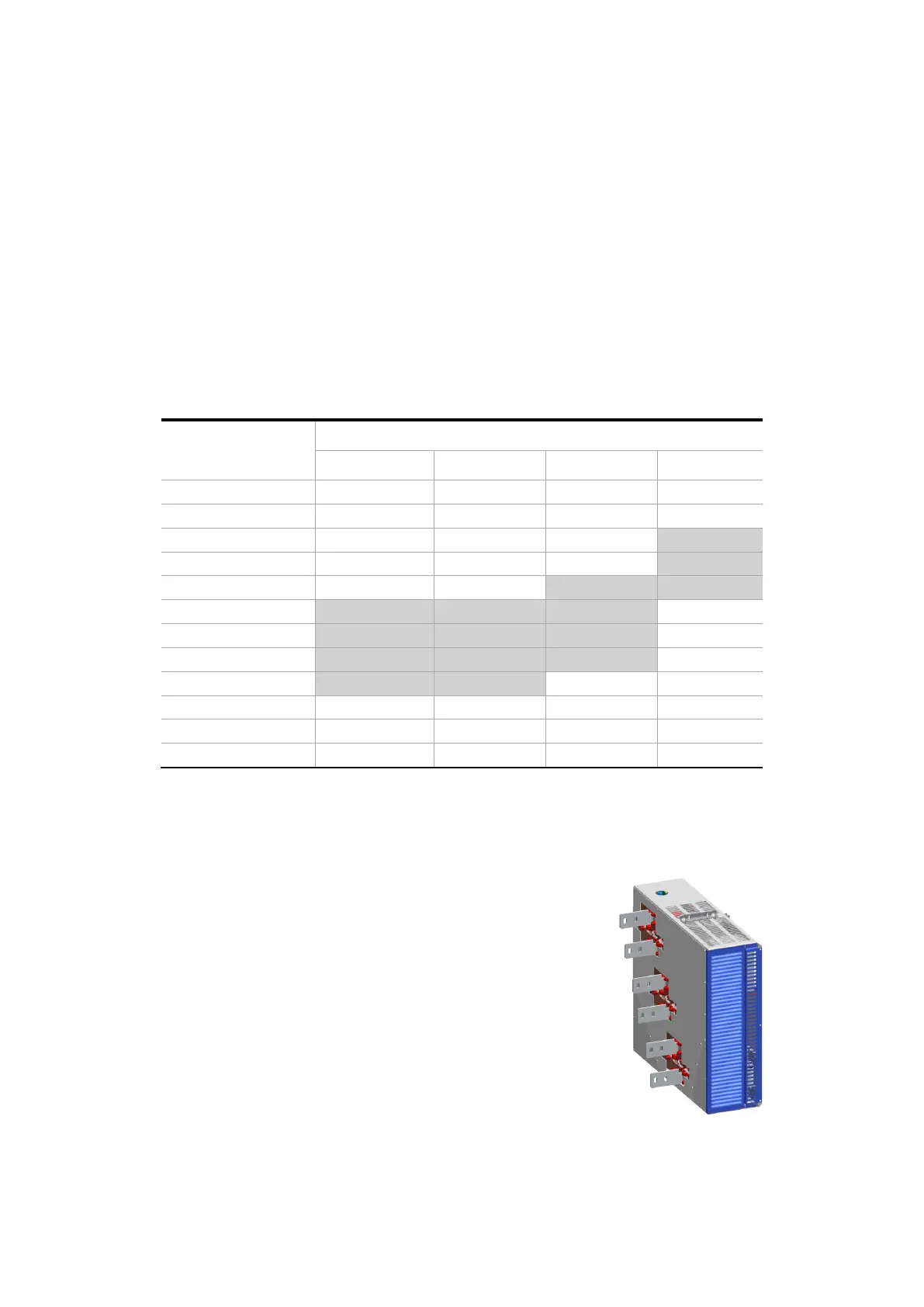
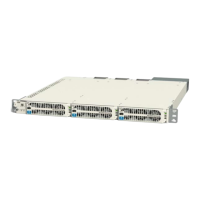
The 900 A Utility Disconnect is module based and it is installed
in the Inverter Enclosure.
The 900 A Utility Disconnect incorporates redundancy in the
form of integrated normally closed Fail-Safe Bypass
contactors that close when the PCS100 UPS-I is turned off or
there is a fault.
The Utility Disconnect cooling fans run continuously.
Cooling air flow is from front to back.


 To Next Page