6
also being recognisable) and assign it to the address of the receiver (1 - 255). In
order to limit the range of supported receivers, unsupported numbers should be
disabled (such disabled number may not be called then) - by deleting such
numbers and leaving the cell empty.
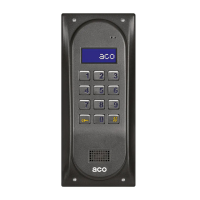
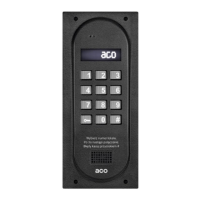
In 230E module, the entry (such as resident or company name) needs to be
selected using arrow keys and followed by pressing the “doorbell” key. Press
and hold the arrow key to display letters of the alphabet to be displayed - then
select a letter and press the “doorbell” key to display the first surname starting
with the selected letter. Alphabetical sorting and first letter search is a default
setting - it can be changed using the computer program (230E, version 7.0 or
later). After disabling this option, pressing and holding the arrow key will display
entries one after another.
The unit will first send the ringing tone (twice by default) and will switch to standby
mode awaiting for the call to be answered. If the call is not answered within 20s,
another single signal is sent and the unit goes into standby again for another 20
seconds. While awaiting for the call to be answered, the display backlighting will
blink. If the call is not answered within some 40s, the door entry unit will
automatically switch from calling to standby mode. Calling can always be
cancelled with the “#” button.
If the call is answered, communication is possible, door can be opened and
additional devices can be controlled (F2). The connection can be ended by
hanging up the handset on the receiver, pressing the "#" key or automatically
after approximately 2 minutes (this time can be set shorter using the computer
program).
The unit also supports eight additional numbers (to be configured using the
computer program).These can be any number, up to six digits, to which physical
addresses of the receivers can be assigned. Additional numbers can be assigned
to the same receiver so that it can be called using different numbers (for instance
two additional numbers and one basic number). Each such additional number
may be configured with different ringing parameters: ring tone, volume, number
of signals, automatic opening and door opening signal when using the access
code (these will be used when additional numbers are the same as basic
numbers). If such additional number is not answered when called, the call can be
redirected to another number (receiver address).
Individual access codes for each apartment are the codes in the table,
corresponding to physical addresses of the receivers (set in uniphones using
jumpers).
When the door is being opened (usually by releasing the E-lock) the display
shows "Enter!" (for persons with hearing impairment) and a signal is heard from
the loudspeaker (for persons with sight impairment). The opening time can also
be changed directly at the door entry unit (it is pre-set to 4 seconds).



 To Next Page