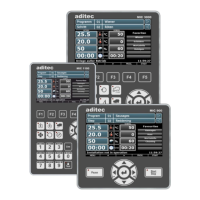
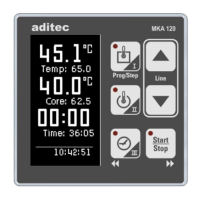
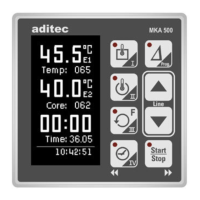
There are 3 different types of buttons for aggregates and aggregate modules:
▪ On/Off buttons
▪ Buttons with interval time. The „On“ time interval is fixed and is pre-configured by the installation
manufacturer. The „Off“ time interval in seconds can be entered for each program by the end user.
▪ Buttons with pulse interval. The base time is fixed and pre-configured by the installation
manufacturer. The end user can enter the length of the pulse interval in percent (in relation to the
base time) in each program.
If single step control has been enabled in the configuration, you
can set it to automatic (GO) or manual (STOP). Setting „GO“ will
disable single step control.
In this display the analogue outputs and their setting value are
listed. This display is only available if the configuration has been
set up accordingly.
2.7 Task bar
2.7.1 Start page / profiles:
The task bar is sub-divided into 5 task buttons. If you leave the start page/standby by pressing a
button, you can get back to standby by pressing the „Start page“ button on any page you may be on.
Menu: Press the „Menu“ button to get to the menu page
(see „Menu page“, item 3, page 20)
Arrow buttons(<, >): Press the arrow buttons right/left to skip forward or backwards from step to step
within a program.
Program: Press the „Program“ button to get to programming mode. For more information see:
item 4, page 21
Start: Starting a program. („Program start“, item 5, page 28)
2.7.2 Programs:
Start page: Calling up standby
Arrow buttons(<<, >>): Skipping through the program list in blocks of 10
Edit: Editing programs
Start: Starting programs. („Program start“, item 5, page 28)



 To Next Page