6TASYS101-1E
TOTAL ACCESS 3000/3010
SYS-101
Page 45 of 46
Total Access
®
3000/3010 System Manual
© 2003, ADTRAN, Inc.
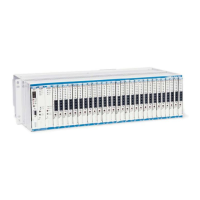
The Total Access 3000/3010 has capacity for 28/22 modules. These are logically
arranged in pairs (1 and 2, 3 and 4, and so on) that are pre-wired in the backplane to
act as auxiliary/main protected pairs. With APS, you can select the option to use the
pairs together via a craft interface to the Total Access System Controller Unit (SCU).
Using APS, the even-numbered slot (2, 4, 6, ...) backs up its odd-numbered counterpart
(1, 3, 5, ...) in a main/auxiliary relationship. If the main circuit experiences any
interruption to service from a card failure to a severed line, the hot-standby auxiliary
will take over the circuit in milliseconds without interruption to customer service. By
default, when the main circuit has been restored, it will automatically take control and
again support customer traffic. Also available are several options that allow you to
“lock in” the auxiliary circuit, or only permit a certain number of switchovers before
the system prevents reversion to an unreliable main circuit. The APS is built into Total
Access 3000/3010 with no external equipment or software required.
In operation, if either the main unit or its loops fail, the auxiliary units pick up the
load. The system automatically reverts to the main units when the failure is corrected.
A provisionable time delay limits switchback for at least one minute to prevent rapid
switch oscillations due to momentary failures. If the main units have repeated failures,
the auxiliary units will remain online continuously instead of reverting to an unreliable
link.
A Total Access 3000/3010 APS circuit can provide another HDSL, HDSL2, or T1 line
in just minutes by disabling the backup circuit and turning it into an independent
carrier. Selected individually, each circuit acts independently of the other; the failure
of one does not affect the operation of the other.





 To Next Page