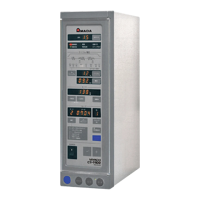
IS-300A
6. Interface
6-3
(2) Description of External I/O Signals
Pin No. Name Description
1
INT.24V
24
V DC present.
When using a contact, open collector (sink type), or PLC
(programmable logic controller) as an input signal (e.g., for
startup or schedule selection), connect pins 1 and 2. (Max.
load: 0.4 A)
Note: Do not use pin 1 unless connecting it to pin 2 or 3, or
connecting pin 34 to drive the solenoid valve. Failure to
observe this precaution will result in malfunction.
2
EXT.COM
When using a contact, open collector (sink type), or PLC
(programmable logic controller) as an input signal (e.g., for
startup or schedule selection), connect pins 1 and 2.
When using an external power supply as input signal, open pin
1 and connect pin 2 and the positive pin of the DC power
supply or the COM pin.
3
STOP
Normally, connect pins 3 and 1.
Opening this pin will cause an error message to appear,
stopping operation.
Open this pin when you wish to stop the sequence halfway
through when using starting signal self-hold input. Open for 20
ms or more when stopping.
4
COM COM pin. This pin is internally connected to the GND chassis.
5
6
7
8
9
10
11
12
SCH 1
SCH 2
SCH 4
SCH 8
SCH16
SCH32
SCH64
SCH128
Schedule input pins.
5: Schedule 1; 6: Schedule 2; 7: Schedule 4; 8: Schedule 8;
9: Schedule 16; 10: Schedule 32; 11: Schedule 64;
12: Schedule 128
(See 4. (9) (f) Schedule Nos. and Schedule Selection Pins.)
13
WE1 STOP/
PARITY
WE1 stop input or Parity input pin.
Switch between functions via the settings on the (9) MODE
SELECT screen described in Chapter 4.
When WE1 STOP is selected
Closing this pin during the WELD1 sequence will switch the
sequence to COOL1.
The welding stop error occurs when the start signal is input
while the WELD1 STOP signal is input.
When this pin is closed before WELD1 welding start after
startup, the current is supplied for at least a control cycle and
WELD1 is stopped to switch the sequence to COOL1.
When PARITY is selected
This pin allows for detection of failure resulting from a wire
break in the schedule selection signal lines. Be sure that the
total number of closed schedule selection and parity signal
lines is always odd. (See 4. (9) (f) Schedule Nos. and
Schedule Selection Pins.)


 To Next Page