29 RS2310002 Rev. 1
Installation Instructions for Freestanding Ranges
Natural Gas
1. Remove storage drawer.
• “Removing Storage Drawer”
section.
2. Locate and remove screws attaching Z-shaped cover
plate.
• Cover plate located in center, rear of storage drawer
cavity.
• Removing cover plate exposes oven burner orifice
and air shutter.
3. Turn orifice hood counterclockwise 2 full turns.
• Support tubing/fitting with wrench while turning
hood.
4. Replace cover plate and storage drawer.
Converting Broiler Burner for Use with
Natural Gas
1. Locate orifice spud attached adjacent to pressure
regulator and remove for later use.
• Orifice spud used for natural gas is silver and is
stamped “52”.
2. Open oven door and locate broiler burner on oven
ceiling.
• Remove oven door to make conversion easier. See
“Removing Oven Door”
section.
3. Remove 2 screws securing front of burner to oven
ceiling and remove broiler.
• Be careful not to damage ignitor as you remove
broiler.
4. Unscrew LP/propane burner spud stamped “58” with
5
/16 inch socket wrench and replace with natural gas
burner spud stamped “52”.
5. Reinstall broiler and, if necessary, oven door.
Gas Connection
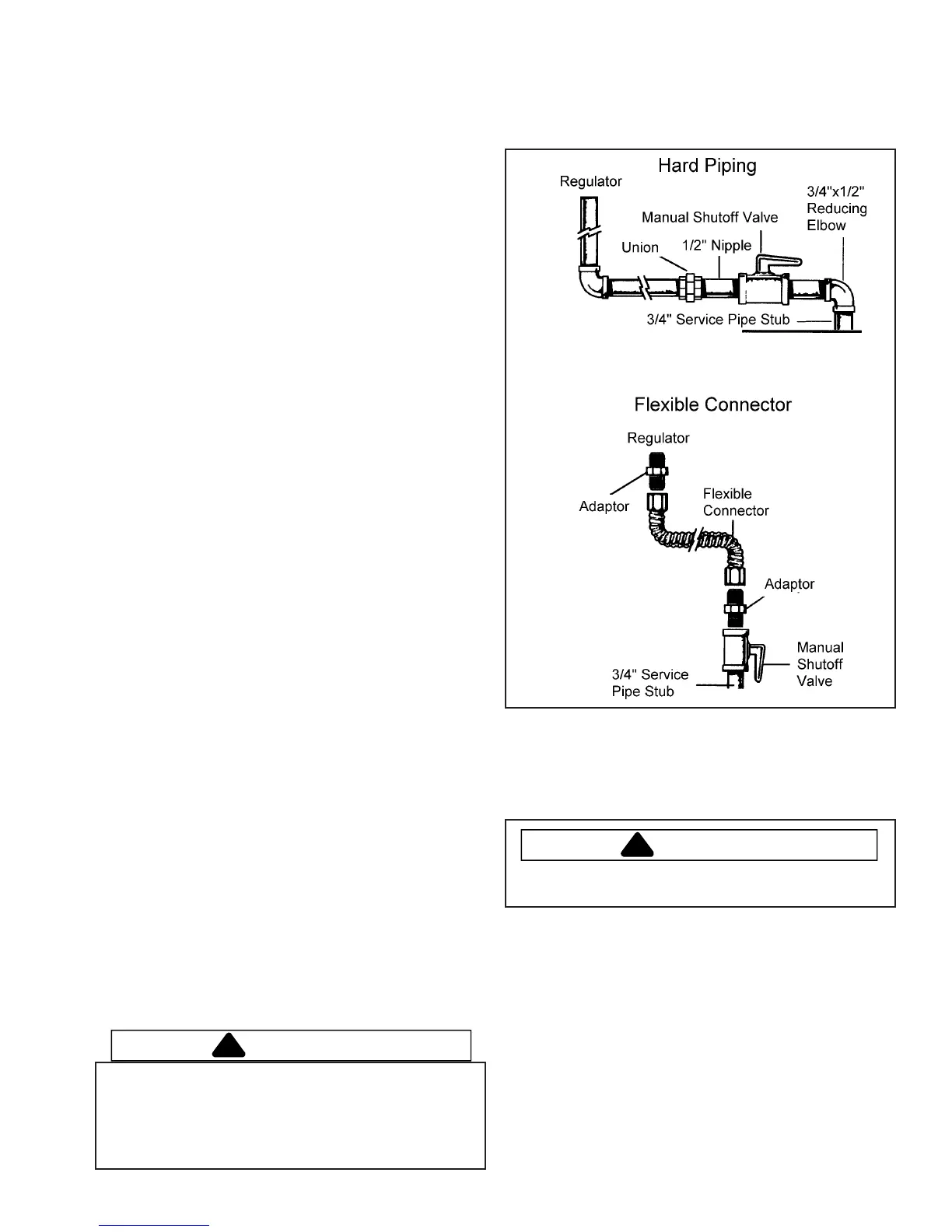
Connect gas supply to regulator using hard pipe or a
flexible connector. Pressure regulator supplied with this
appliance has a ½ inch NPT female connection. If gas
union is used, remove storage drawer, slide range into
place, and connect union. See figure below.
• A manual shutoff, not supplied with range, must be
installed in an accessible location outside of range.
• Use joint compound that is resistant to action of
propane gas on all male pipe threads.
• Use supplied pressure regulator only.
• Do not overtighten gas fitting when attaching to
pressure regulator. Overtightening may crack regulator.
• Support pressure regulator with wrench when installing
gas fitting.
WARNING
To avoid property damage or personal injury, only use a
new flexible connector that is AGA/CGA design
certified.
• Do not use an old connector.
• Do not reuse a connector after moving
appliance.
Testing for Gas Leaks
After final gas connection is made, turn on manual gas
valve and test all connections in gas supply piping and
range for gas leaks.
WARNING
To avoid property damage or serious personal injury,
never use a lighted match to test for gas leaks.
1. Place soap suds on connection.
• Bubbles appear if leak is present.
2. If bubbles appear, shut off gas supply valve.
3. Tighten joint if leak is at factory fitting.
• If leak is not at factory fitting, unscrew, apply more
joint compound, and tighten to correct leak.
4. Retest connection for leak after tightening.
• Retest any connections that were disturbed.



 To Next Page