ii
INTRODUCING THE A-2000 BIS MONITORING SYSTEM
INDICATIONS FOR USE
The Aspect A-2000 EEG Monitor with BIS is intended for use under the direct
supervision of a licensed healthcare practitioner or by personnel trained in its proper
use. The BIS Monitor is intended for use on adult and pediatric patients within a hospital
or medical facility providing patient care to monitor the state of the brain by data
acquisition of EEG signals.
The BIS may be used as an aid in monitoring the effects of certain anesthetic agents.*
Use of BIS monitoring to help guide anesthetic administration may be associated with
the reduction of the incidence of awareness with recall in adults during general
anesthesia and sedation.
INTRODUCTION
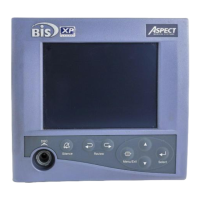
The A-2000 BIS Monitoring System is a user-configurable patient monitoring system
designed to monitor the hypnotic state of the brain based on acquisition and processing
of EEG signals. The A-2000™ processes raw EEG signals to produce a single number,
called the Bispectral Index, or BIS, which correlates with the patient's level of hypnosis.
The A-2000 monitor display consists of:
• The current BIS number
• Trend plots of processed EEG parameters
• Raw EEG waveforms in real time
• Density Spectral Arrays (DSA)
• Numeric BIS log
• Various signal quality indicators (EMG, SQI).
• Suppression Ratio and Burst Count number.
The system performs self-tests to ensure that the monitor and its components are
functioning properly and that impedance levels of patient sensors are within acceptable
limits. Easy-to-use menus allow the user to mark events, review and clear stored data,
and change the data display.
* Gan TJ, Glass P, Windsor A, Payne F, Rosow C, Sebel P, Manberg P. Bispectral
Index Monitoring Allows Faster Emergence and Improved Recovery from
Propofol, Alfentanil and Nitrous Oxide Anesthesia. Anesthesiology October 1997;
(4) 87:808-15.


 To Next Page