
 Need help?
Do you have a question about the Athena Controls 16C Series and is the answer not in the manual?
Instructs to inspect the instrument for shipping damage and save packing materials.
Lists the various functionalities and capabilities of the controller.
Lists UL E66598 approval for Temperature Indicating and Regulating Equipment.
Warns about fire hazards, damage, injury, and electrical connections.
Details steps for inspecting the controller for damage and verifying the order code.
Presents the physical dimensions and cutout size requirements for panel mounting.
Describes how to insert the controller through the panel cutout and secure it.
Identifies the controller's terminals for alarm, communication, sensor input, and outputs.
Details the correct wiring for thermocouple sensors, including extension wires.
Explains how to connect 2-wire and 3-wire RTDs, including jumper settings.
Introduces wiring for optional hardware modules.
Describes wiring for dual alarm outputs (NO/NC) and their load limits.
Explains wiring for Option #21: Dual 24 V outputs with clamping diodes.
Details wiring for Option #30: RS-232 (one-to-one) communications.
Describes wiring for Options #40, #41, #42: Contact/Digital Input with Alarm.
Explains wiring for auxiliary output options (60-63).
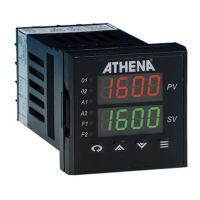
Identifies and describes the function of each button and LED on the controller's front panel.
Details the power-on diagnostic checks and initial display sequence.
Describes controller output activation, display behavior, and setpoint handling upon power-up.
Details the different security levels (Key Lockout to Factory) and their access privileges.
Lists and describes the available operating modes for the controller.
Explains how to access and navigate the various menus and parameters.
Provides a table and descriptions for each main menu (Input, Display, Output, Control, etc.).
Lists the available input types and their corresponding jumper settings.
Provides a table of minimum and maximum values for various sensor types.
Explains the PID tuning parameters: Proportional Band, Derivative, Integral, and Manual Reset.
Explains the critical On/Off control parameters: deadband and hysteresis.
Explains how to set a ramp from the current process value to the setpoint over a specified time.
Details parameters for recipe options like Single Setpoint Ramp and Multi-Step Ramp.
Defines key terms related to autotuning like Cycle Time, Proportional Band, Integral, and Derivative.
Lists the available serial communication options.
Lists the available digital input options.
Lists the available RS-485 Modbus communication options.
Lists the available transducer excitation options.
Lists the available auxiliary output options.
Continues the FAQ section, covering PV display flickering and unexpected setpoint changes.
 General
| Brand | Athena Controls |
|---|---|
| Model | 16C Series |
| Category | Controller |
| Language | English |

 To Next Page