89000046-014 KSN 780/8XX/900 AeroNav AML STC Installation Manual for Helicopters
Rev 0 Page-3-3
© Honeywell International Inc. Do not copy without express permission of Honeywell.
3.3.1.1 Aircraft Lightning Zone
If installing an Avidyne GPS Antenna (Avidyne Part Number 200-00282-000), the GPS antenna is
qualified to be installed in an aircraft lightning zone 2A or 3 as defined by SAE ARP5414A and RTCA
DO-160G. The GPS antenna can be installed anywhere in a zone 2A or zone 3 area. The forward nose
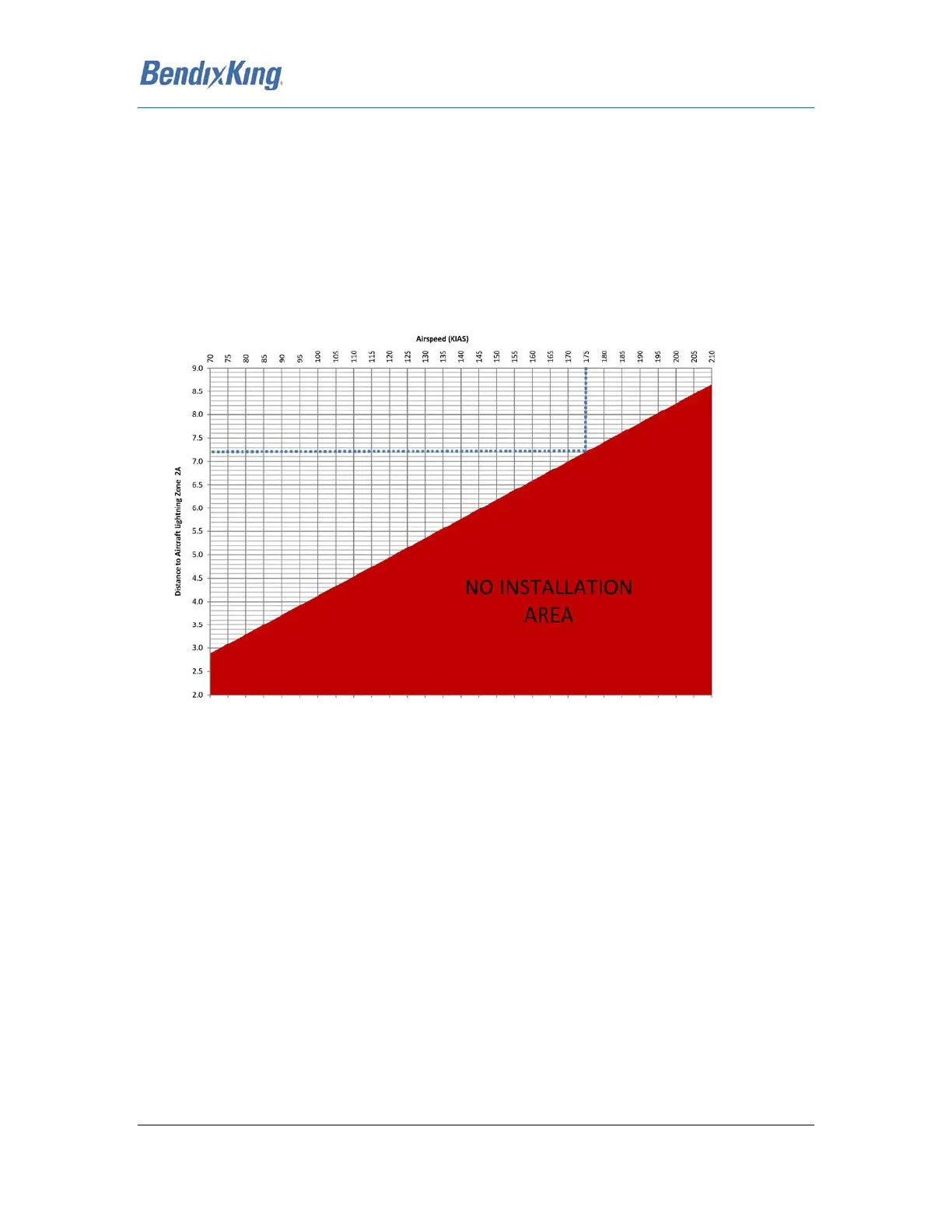
zone 1A or 1B the No Installation Area can be determined using Figure 1 Distance to Aircraft
Lightning Zone 2A. The distance found by using Figure 1 defines a zone immediately aft of the nose of
the helicopter where the GPS antenna should not be installed. Helicopter locations aft of zone 1A, 1B
that are in a zone 2A or zone 3 are acceptable to install the GPS antenna. Figure 2 below shows an
example of the SAE zoning map for helicopters.
Figure 1 Distance to Aircraft Lightning Zone 2A
Procedure:
1. Determine the Maximum Cruising Speed (V
no
) for the
helicopter. Note: Indicated Airspeed in knots (KIAS) must be
used in the table.
2. Locate the Airspeed for the helicopter on the Horizontal Axis
of the table. Draw a vertical line from the Airspeed to the No
Installation Area.
3. Draw a horizontal line from the No Installation Area, found in
Step 2, to the Vertical Axis on the chart.
4. Determine the Distance (in feet) to Aircraft Lightning Zone 2A
for the helicopter on the Vertical Axis.


 To Next Page