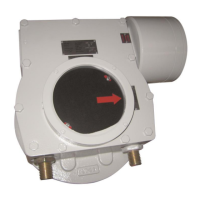
Electric Actuator ICON2000/ICON2000AD
ADDENDUM G to INSTRUCTION HANDBOOK MAN 618
© Copyright by BIFFI Italia. All right reserved. Page
17
7.7 Safety Instructions for installation in Hazardous
(Classified) Location
National Electrical Code is mandatory in order to safeguard person and
property from hazard arising from the use of electricity and in especially when
use electrical equipment in Hazardous (Classified) Location. Therefore the
requirements of the NEC are considered necessary for the safety, compliance
therewith and proper maintenance result in a installation that is adequately free
from hazard.
The NEC is not intended as a design specification or an instruction manual for
untrained person. Chapter 5 Special Occupancies cover the rules for
installation in Hazardous Location.
7.7.1 Basic Instructions for the explosion proof electrical equipment
Important:
Electric Actuator shall be installed and maintained
according to the National Electrical Code Article 501, 502
and 503 regarding the electrical installation in Hazardous
(Classified) Location as
Class I Division 1 and 2,
Class II Division 1 and 2 and
Class III Division 1 and 2
7.7.1.1 Class I Division 1 and 2
The general rules of the National Electrical Code®, Article 501 shall apply to
the electrical wiring and equipment in location classified as Class I in Article
500.5 of NEC and in particular:
- wiring methods shall comply with 501.10
- wealing and drainage shall comply with 501.15
- conductor insulation shall comply with 501.20
- grounding and bonding with 501.30
- equipment shall comply with 501.100 up to 501.150
Particular care shall be taken in explosion proof installation because of the
possibility of pressure piling and because of the possibility of communication
of a hazard form one location to another through conduit, it is required that
seals be used in all conduit.
There shall be no union, couplings, box, or fitting in the conduit between the
sealing fitting and the point at which the conduit leaves the Division 1 area and
enters the Division 2 area, or leaves the Division 2 area and enter a non-
hazardous area.
Conduits must be installed to prevent water accumulation.
Cables must be sealed in accordance these same criteria unless the cable
construction makes it as tight against passage of gases a conduit seal.



 To Next Page