“ICON 2000v4"
instruction and operating manual
© Copyright by BIFFI Italia. All right reserved. Section 618/42 Page 3
Contents may change without notice
5. PROFIBUS DP description
PROFIBUS is a vendor-independent, open field bus standard used in a wide range of application in
process automation. Vendor independence and openness are ensured by the international standards
EN 50170 and EN 50254. The DP communication profile is designed for data exchange at the field
level. The central controllers (as PLC) communicate via serial connection with field devices (as
sensors and actuators). Data exchange is mainly cyclic. The central controller (called Master)
cyclically reads the input information from the field devices (called Slaves) and cyclically writes the
output information to the slaves. In addition PROFIBUS DP provides communication services for
parameterisation, alarm handling, and monitoring of intelligent field devices. The maximum
number of Master and Slave devices in a bus segment is 32 without repeaters. With repeaters the
number can be extended to 126. The maximum cable length depends on the speed of transmission.
Higher is the speed shorter is the length. For instance, with baud rate 93.75 Kb/sec, the max cable
length is 1,200m without repeaters.
Mono-master or multi-master system configuration can be provided. Bus access is controlled by
token passing procedure between masters and master-slave procedure (polling) between master and
slaves.
Types of devices:
DP Master Class 1 (DPM 1): this is the central controller that cyclically exchange information
with the field devices. Typical devices are PLC or PC.
DP Master Class 2 (DPM 2): this devices are necessary for commissioning, maintenance and
diagnostics.
Slave: field device such transmitters, actuators, drives, etc.
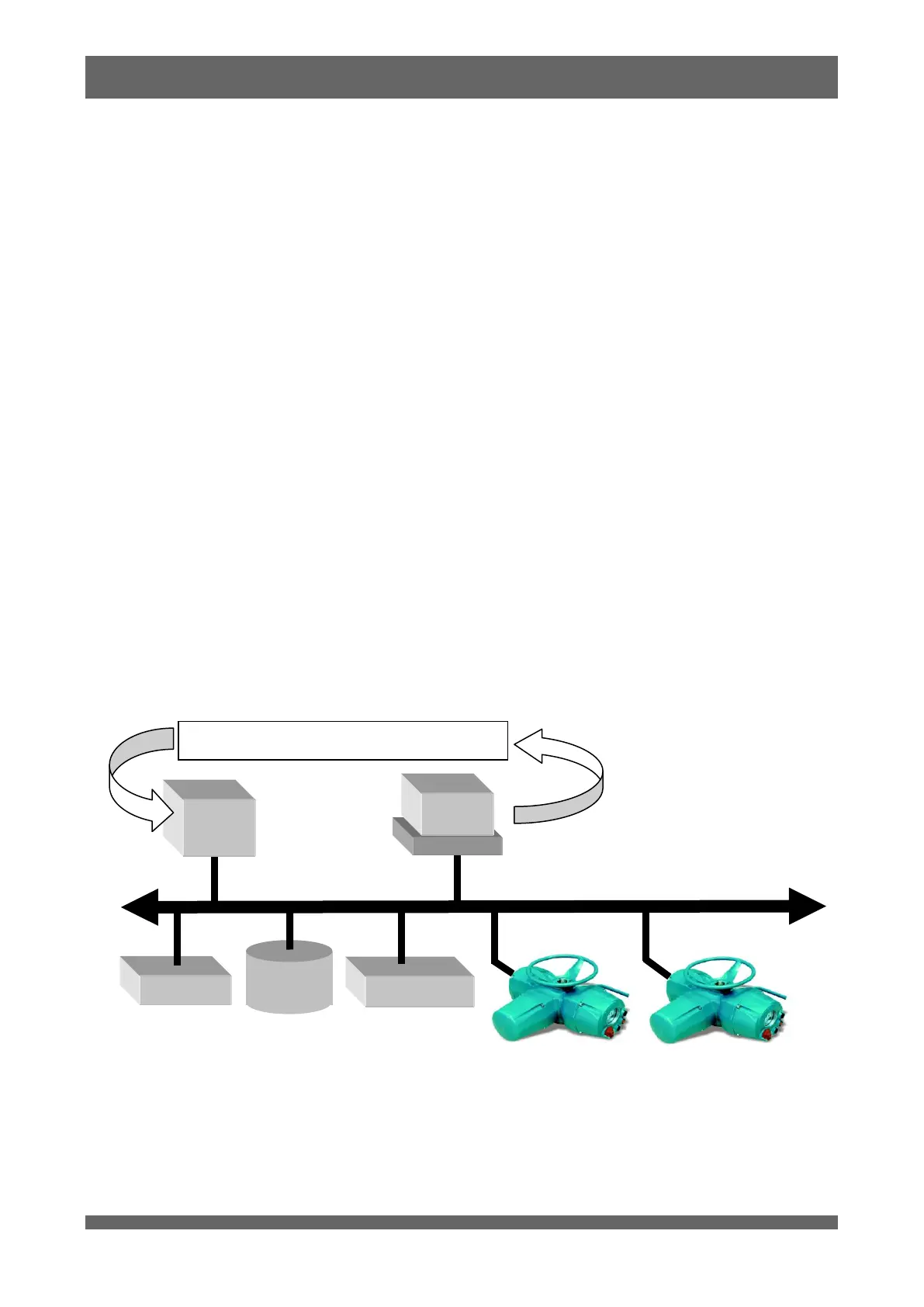
The figure below shows a PROFIBUS DP configuration with two Master devices and different
Slave devices.
Logical token ring between master devices



 To Next Page