“ICON 2000v4"
instruction and operating manual
© Copyright by BIFFI Italia. All right reserved. Section 618/42 Page 7
Contents may change without notice
7. Slave Redundancy
The ICON2000v4_DPV1 is designed to allow the actuator to acts as a redundant slave as described
in the PROFIBUS “Specification Slave Redundancy” Version 1.1.
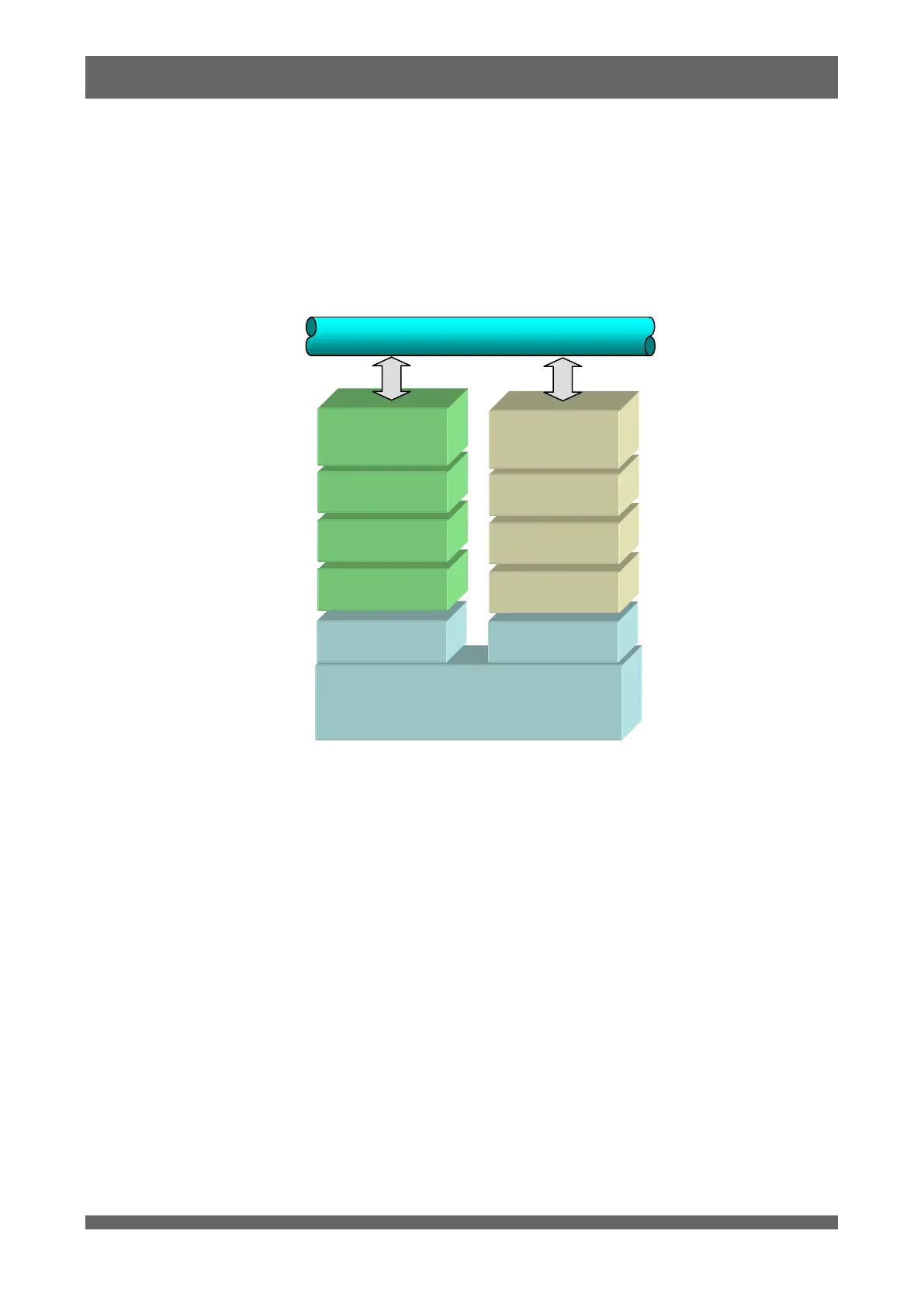
To achieve the Slave Redundancy two ICON2000v4_DPV1 modules are mounted in the actuator:
in this way the actuator is equipped with a full redundant communication interface as specified by
the PROFIBUS Guideline. The schematic of the Redundant Slave is as follow:
The two interfaces are indicated as Primary Slave and Backup Slave. The following simple rules
define the redundancy strategy:
An internal arbitration defines at the start-up the role of the interfaces.
The base card tries first to establish a valid communication with the Primary Slave.
There is always just one Slave (Primary or Backup) with a valid communication with the
PROFIBUS line. It is indicated Active Slave.
Both Slaves can answer to PROFIBUS interrogation: only the Active Slave has valid data and
this condition is indicated by a specific bit in the cyclic communication.
Both Slaves receive the commands from Master but the base card can execute only the
commands from the Active Slave.
When the Primary Slave stops to work or its interface does not sense any PROFIBUS
communication the base card enables the Backup Slave that becomes Active.
After the Primary Slave fails the PROFIBUS communication continues via the current Active
Slave. A maintenance service is necessary to restore the Primary Slave.
The PROFIBUS slave addresses are assigned for each interface from the Local Operator
Interface of the actuator and the addressing is depending on the redundant system structures that
has been selected.
PROFIBUS
RS485
Transceiver
PROFIBUS
RS485
Transceiver



 To Next Page