91
© Copyright by BIFFI Italia. All rights reserved.
“ICON2000”
instruction and operating manual
Section 618/3 chapt. M
Section 618/3
CHAPTER
M
MAINTENANCE
1. Standard maintenance
Approx. every 2 years:
Under normal operating conditions, the ICON2000 is maintenance-free: no actuator
maintenance is formally required, even though visual inspection for oil leakage or external
visible damages is recommended every two years. When conditions are severe (frequent
operation or high temperatures), inspect the oil level and oil quality more often. Replace all
seals that permit oil leakage or water ingress.
Important: Before starting any maintenance operation, make sure that
the mains and all other service voltage connected to terminal
board are switched-off.
Warning: The actuator is non-intrusive. The control compartment was
sealed in dry and clean conditions and contains no site
serviceable components. Do not open it unless absolutely
necessary. Unauthorised access will invalidate the warranty.
Warning: Since the control compartment contains a 3.6V lithium
battery, only open it in safe area. If the actuator is located in
a hazardous area a “hot work” permit must be obtained
unless the actuator can be moved to a non-hazardous area.
The following checks will assure optimum performance:
- If the stem is external, check that the valve stem is clean and lubricated. If not, clean it and
lubricate it in order to prevent damages to the threaded bush.
- Lubricate the internal components of the coupling block by means of the spherical head
lubricator using suggested greases (see Sect. 618/1 chapt. D).
- Make sure there are no oil leaks from the actuator housing. The oil level should be approx.
20 mm. from the fill plug (see Sect. 618/1 chapt. D).
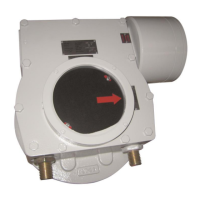
- Check the external parts for possible damage and replace them immediately, if necessary.
In case the window glass is broken, the complete cover must be replaced (see Sect.
618/4 for individual item numbers).
- Repaint all areas where paint is missing. In chemically aggressive or saline environments,
remove rust from surfaces and protect with a rust preventative.
- Check that all nuts and bolts securing the actuator to the valve are tight. If necessary,
re-tighten with a dynamometric key (for tightening torque values see Sect. 618/1 chapt. C
par. 4.3).
- For severe applications or if actuator operation is infrequent, perform maintenance checks
more often.
- For actuators provided with lithium batteries, make sure that the display is still visible when
power is off and that there is no “Battery low” warning message. If "Battery low" warning
appears, replace the battery.
Always replace batteries if the actuator has been subjected to long periods without power.



 To Next Page