CHAPTER 2: PRODUCT OVERVIEW
21
Administration using the Octoware software
The Octoware Java-based system administration software tool is supplied with each Octet
switch. Use it to assign names to attached target devices and users, designate user
access rights, monitor switching system events, and upgrade firmware. You can also use
Octoware software to configure Octet switching system installations remotely,
eliminating the need to configure each unit separately.
System monitoring using the SNMP interface
The Octet switch supports the Simple Network Management Protocol (SNMP) to
remotely monitor the switch via the ethernet port. Once SNMP is configured, you can use
the SNMP protocol to manage and control user stations and their connections in the
switching system.
2.2 Glossary
The following terms are used throughout this documentation:
• Cascading – Connecting multiple KVM switches to an Octet switch, providing
additional connections for target devices. Cascading expands the number of target
devices that can be connected to the Octet switching system.
• Console – The user station and peripheral devices used by each local user.
• Octet server access module – T
he primary interface between an attached device (KVM
switch, serial device or PS/2, Sun or USB server) and the
Octet
switching system.
Octet server access
modules are server-powered and provide keyboard emulation,
DDC (Digital Data Channel) and
Octet
switching system support.
• Peripheral devices – The set of communication devices connected to each user
station. May include keyboard, monitor, mouse, speakers and headphones.
• Switch – Equipment that provides KVM connectivity to attached target devices.
• Switching system – A set of switches and attached target devices, user stations, Octet
server access modules and peripheral devices.
• Target device – Equipment such as a server or serial device that is attached through
an Octet server access module to a switch or user station and can be accessed through
the switching system.
• Unit – Includes switches, user stations and target devices; this term is used when the
procedure is referring to any or all.
• User station – The interface between the Octet switch and system users, storing local
(console) settings and providing connections for peripheral devices. The user station
also provides the OSD for target device selection and administration.
2.3 Component Overview
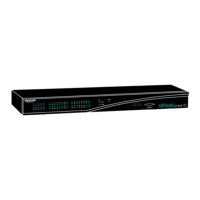
An Octet switching system typically consists of four main components:
• One or more Octet switches.
• One or more Black Box Octet matrix user stations.
• One or more Black Box Octet server access modules, available in several different
types including the SAM, SAMDM and Serial SAM modules.
• Unshielded Twisted Pair (UTP) cables.
A typical Octet switching system configuration is illustrated in Figure 2-1.




 To Next Page