
 Need help?
Do you have a question about the Bosch DCNM-SERVER and is the answer not in the manual?
Precautions for connecting to the public mains network and handling interventions.
Guidelines for product disposal, EMC compliance, and modification warnings.
Compliance statements for FCC and Industry Canada wireless regulations.
Details the manual's purpose, target audience, and scope.
Explains signs, legal disclaimers, and documentation update history.
Overview of system configurations like daisy-chain and star setups.
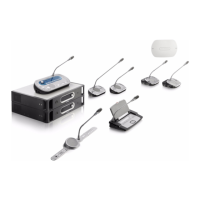
Illustrates a typical DICENTIS Conference System configuration and lists components.
Diagram and explanation of a typical camera setup in the system.
Describes system scalability for small, medium, and large configurations.
Explains subnet definition and recommended subnet mask for IP addressing.
Illustrates a multi-subnet system with up to 750 devices.
Factors affecting system capability like cable length and device count.
Discusses the impact of system network cable length on power capacity.
Explains how cable length and connected devices determine power supply needs.
Introduces a tool for calculating total system power capacity.
Specifies requirements for switches used in the DICENTIS system.
Details QoS settings and DSCP values for switch priority queues.
Outlines requirements for using RSTP with redundant wiring.
Specifies tools for network diagnoses like Link Layer discovery and SNMP.
Lists minimal requirements for routers in the system.
Guides on calculating power supply using specific units or general methods.
Table listing power consumption for various device types.
Explains how to calculate power supply using PoE Ethernet switches.
Notice about limitations of PoE switches and daisy-chaining.
Steps for configuring redundancy options, including RSTP activation.
Describes creating redundant cabling for specific power units.
Outlines possibilities and requirements for creating redundant loops with power units.
Explains how to improve system availability with a redundant server PC.
General recommendations for installation products and cable handling safety.
Introduces cable couplers and their various uses.
Explains using cable couplers for extending cables and as break-out boxes.
Details using cable couplers as interfaces between cable types.
Explains using cable couplers for local power insertion.
Describes using cable couplers to switch the system on.
Introduces DICENTIS system cable assemblies and their specifications.
Details connectors for making or replacing DICENTIS system network cables.
Describes the toolkit used for connecting DICENTIS cable connectors.
Introduces a 250-meter installation cable for making custom network cables.
Describes an accessory for the DICENTIS Interpreter desk.
Details the function and scope of delivery for these units.
Instructions for installing the audio processor/powering switch.
Information about the DICENTIS System server and its pre-installed software.
Server installation steps, EULA handover, and accessory information.
Details the OMNEO Dante gateway features and mechanical specifications.
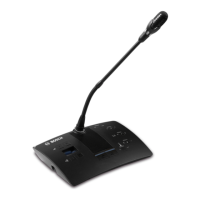
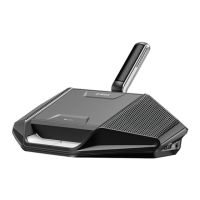
Describes DICENTIS tabletop devices (DCNM-MMD / DCNM-MMD2).
Information on device compliance, potential interference, and specific device models.
Explains daisy-chain and star configurations for connecting devices.
Instructions for installing devices, including mounting and connection notices.
Describes DICENTIS flush-mounted devices (DCNM-FSL).
Instructions for flush-mounted device installation using snap-mounting and click-to-fit.
Describes the block-mounting method for flush-mounted devices.
Details recess dimensions for block-mounting using couple pieces.
Explains how number-size factor affects recess length.
Instructions for removing flush-mounted devices using extraction tools.
Describes connecting and using the DCNM-FSL language selector.
Details how to connect an external headphones socket.
Notices and warnings regarding headphone connection, electrical floating, and ESD.
Describes the functions and controls of the interpreter desks.
Describes DICENTIS microphones and their connection.
Step-by-step guide for connecting and removing microphones.
Instructions for applying an anti-reflection foil to multimedia device screens.
Describes the name card holder for DICENTIS multimedia devices.
Preconditions for starting the installation test.
Steps to initiate the system installation test.
Information on how to contact customer service for unresolved faults.
 General
| Category | Conference System |
|---|---|
| Model | DCNM-SERVER |
| Manufacturer | Bosch |
| Power Supply | 100-240 VAC, 50-60 Hz |
| USB | 2x USB 2.0 |
| Network Interface | 2x Ethernet (1000Base-T) |
| Supported Protocols | TCP/IP, HTTP, HTTPS, SNMP, RTP |
| Operating Temperature | 0°C to 40°C (32°F to 104°F) |
| Storage Temperature | -20 ºC to +60 ºC (-4 ºF to +140 ºF) |
| Dimensions (H x W x D) | 44 mm x 430 mm x 360 mm (1.73 in x 16.93 in x 14.17 in) |
| Mounting | Rack mount (19 inch) |



 To Next Page