Brookeld Engineering Labs., Inc. Page 80 Manual No. M13-167-A0415
VII. MATH MODELS
VII.1 The Power Law (Ostwald) Model
(τ=shearstress,k=consistencyindex, =shearrate,andn=owindex)
What does it tell you?
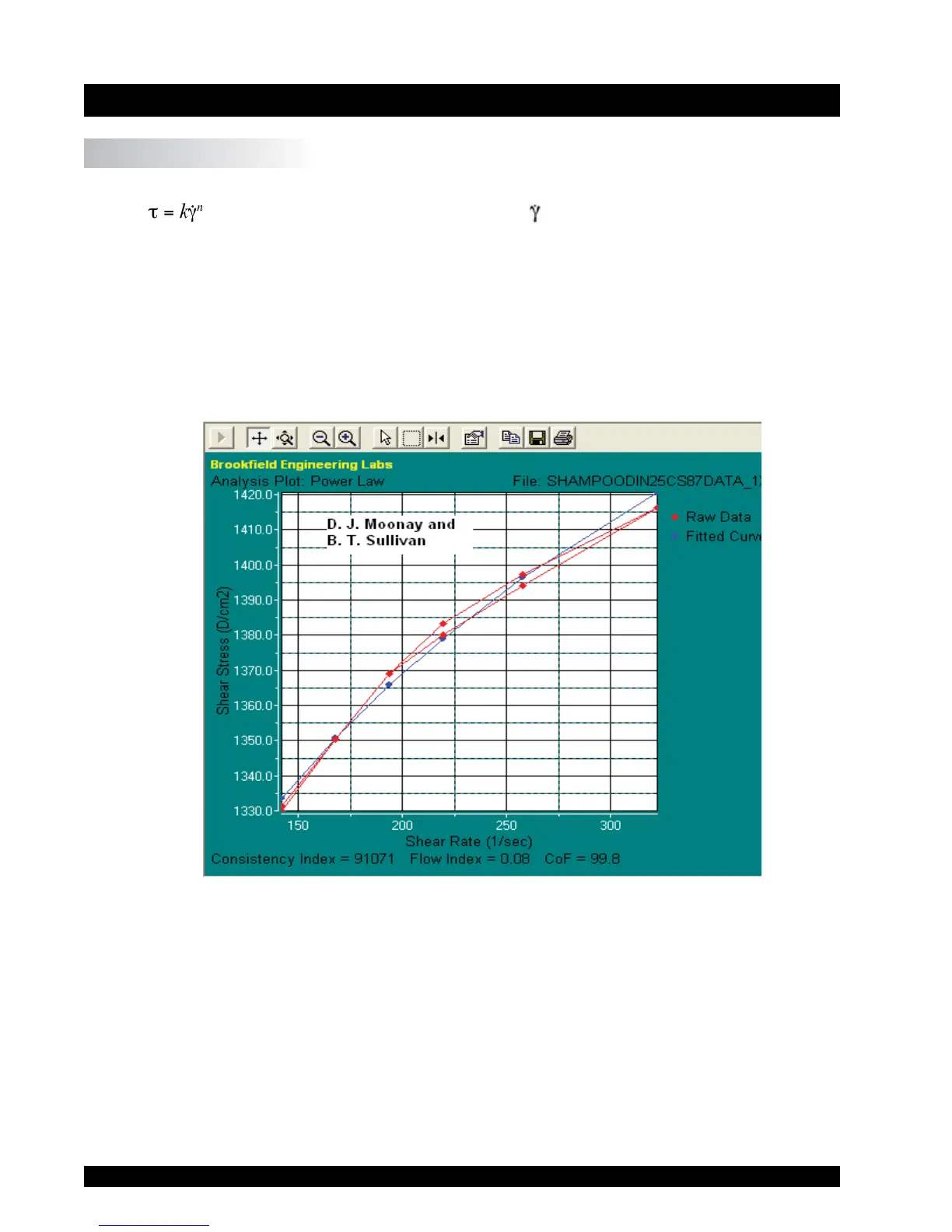
ThePowerLawmodelprovidesaconsistencyindex,k,whichisaproduct’sviscosityatone
reciprocalsecond.(Reciprocalseconds aretheunitsofmeasurementforshearrate.) It also
providesaowindex,n,whichindicatesthedegreewithwhichamaterialexhibitsnon-Newtonian
owbehavior.SinceNewtonianmaterialshavelinearshearstressvs.shearratebehaviorand
ndescribesthedegreeofnon-Newtonianow,theowindexessentiallyindicateshow“non-
linear”amaterialis.
Figure VII-1
Whenn<1theproductisshear-thinningorPseudoplastic.Thismeanstheapparentviscosity
decreasesasshearrateincreases.Theclosernisto0,themoreshearthinningthematerialis.
Whenn>1theproductisshear-thickeningorDilatant.Theirapparentviscosityincreasesas
shearrateincreases.
When should you use it?
Thismodelshouldbeusedwithnon-Newtonian,time-independentuidsthatdonothaveayield
stress.Theseuidswillbegintoowunderanyamountofshearstress.Graphsofsuchmaterial
generallyintersectthey-axisat0.




 To Next Page