VEHICLE LOADING CHART
Follow these steps to determine the total weight the vehicle can carry:
1. Determine the cargo capacity of your vehicle.
○
Load Capacity = GVWR – Curb (weight of vehicle, full fluids, no occupants).
2. Determine occupant count.
○
For calculation purposes, average weight of an occupant is 150 lb (68 kg).
EXAMPLE:
•
GVWR = 6,005 lb (2,723 kg)
•
CURB = 4,500 lb (2,041 kg)
•
Load Capacity = GVWR – CURB = 6,005 lb (2,723 kg) - 4,500 lb (2,041 kg) = 1,505 lb (682 kg)
4 Occupants (at 150 lb [68 kg]) + Max Trailer =
•
1,505 lb (682 kg) – 600 lb (272 kg) (4 x 150 lb [68 kg]) – 360 lb (163 kg) (10% of 3,600 lb [1,632 kg]) = 545 lb (247 kg) of cargo in vehicle
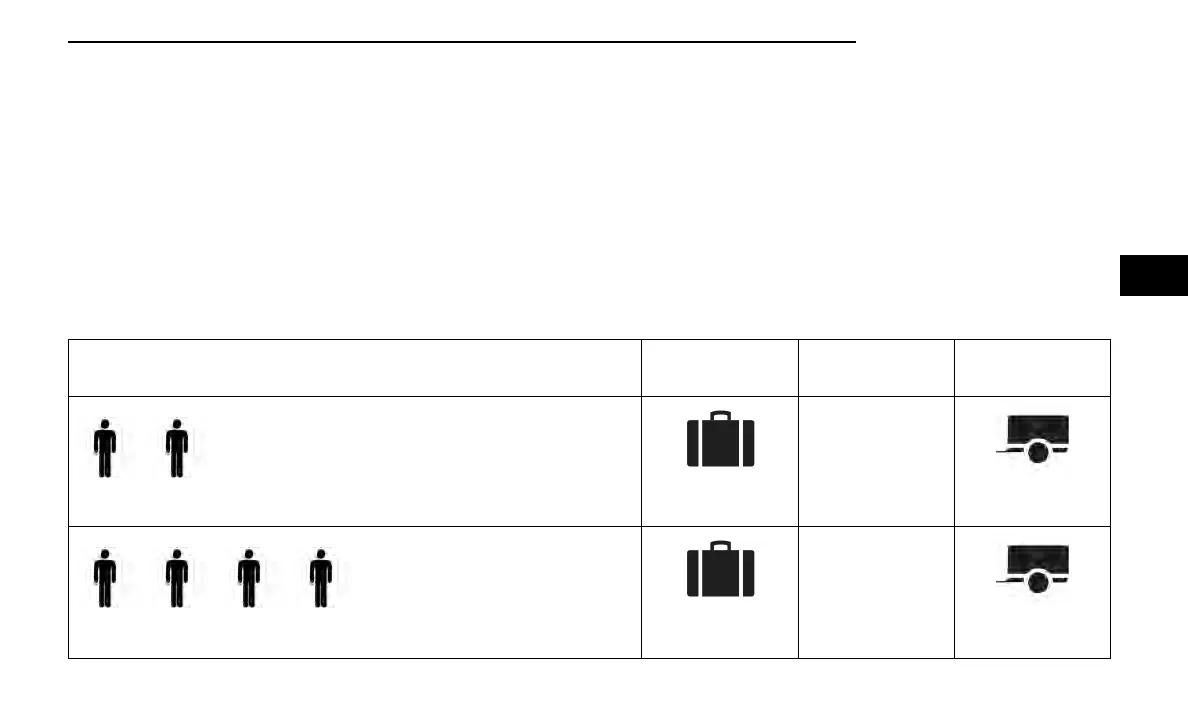
Number Of Persons / Weight Of Occupants Max Cargo No Trailer
Max Trailer TW, Max
Trailer
Max Cargo With Max
Trailer TW 360 lb
(163 kg)
2 People / 300 lb (136 kg)
1,205 lb (546 kg)
1,205 lb (546 kg) – 360
lb (163 kg) = 845 lb
(383 kg)
845 lb (383 kg)
4 people / 600 lb (272 kg)
955 lb (433 kg)
955 lb (433 kg) –
360 lb (163 kg) =
545 lb (247 kg)
545lb(247kg)
STARTING AND OPERATING 163
4














 To Next Page