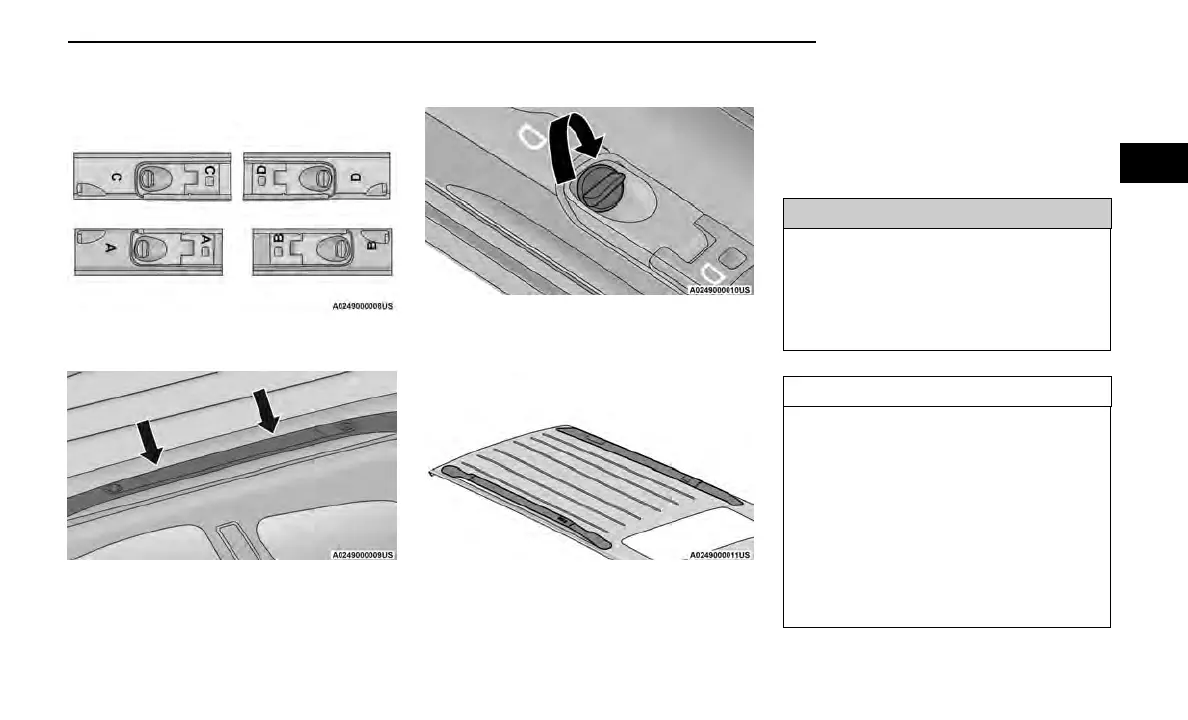
3. Then, position the crossbar along the correct side
rail. Make sure the letters on the crossbar align with
the matching letters on the side rail.
4. The crossbar will nest fully within the side rail.
5. Once the driver’s side crossbar is in place, tighten
the thumb screws completely.
6. Repeat the procedure to stow the second crossbar
on the opposite side.
NOTE:
•
To help control wind noise, stow the crossbars in the
side rails when they are not in use.
•
If any metallic object is placed over the satellite
radio antenna (if equipped), you may experience
interruption of satellite radio reception.
WARNING!
Cargo must be securely tied down before driving your
vehicle. Anything improperly secured to the roof rack,
crossbars, or the roof itself can fly off the vehicle,
particularly at high speeds, resulting in collisions,
personal injury, or property damage. Follow the roof
rack cautions when carrying anything on your roof
rack.
CAUTION!
•
To prevent damage to the roof of your vehicle, DO
NOT carry any loads on the roof rack without the
crossbars deployed. The load should be secured
and placed on top of the crossbars, not directly on
the roof. If it is necessary to place the load on the
roof, place a blanket or other protective layer
between the load and the roof surface.
•
To avoid damage to the roof rack and vehicle, do
not exceed the maximum roof rack load capacity of
150 lb (68 kg). Always distribute heavy loads as
evenly as possible and appropriately secure the
load and any protective layer placed between the
load and the roof surface.
(Continued)
Stowing Crossbars
Crossbar To Side Rail
Tightening Crossbar
Stowed Crossbars
GETTING TO KNOW YOUR VEHICLE 97
2












 To Next Page