Description of fields within Register file: 0x1F – Channel Control
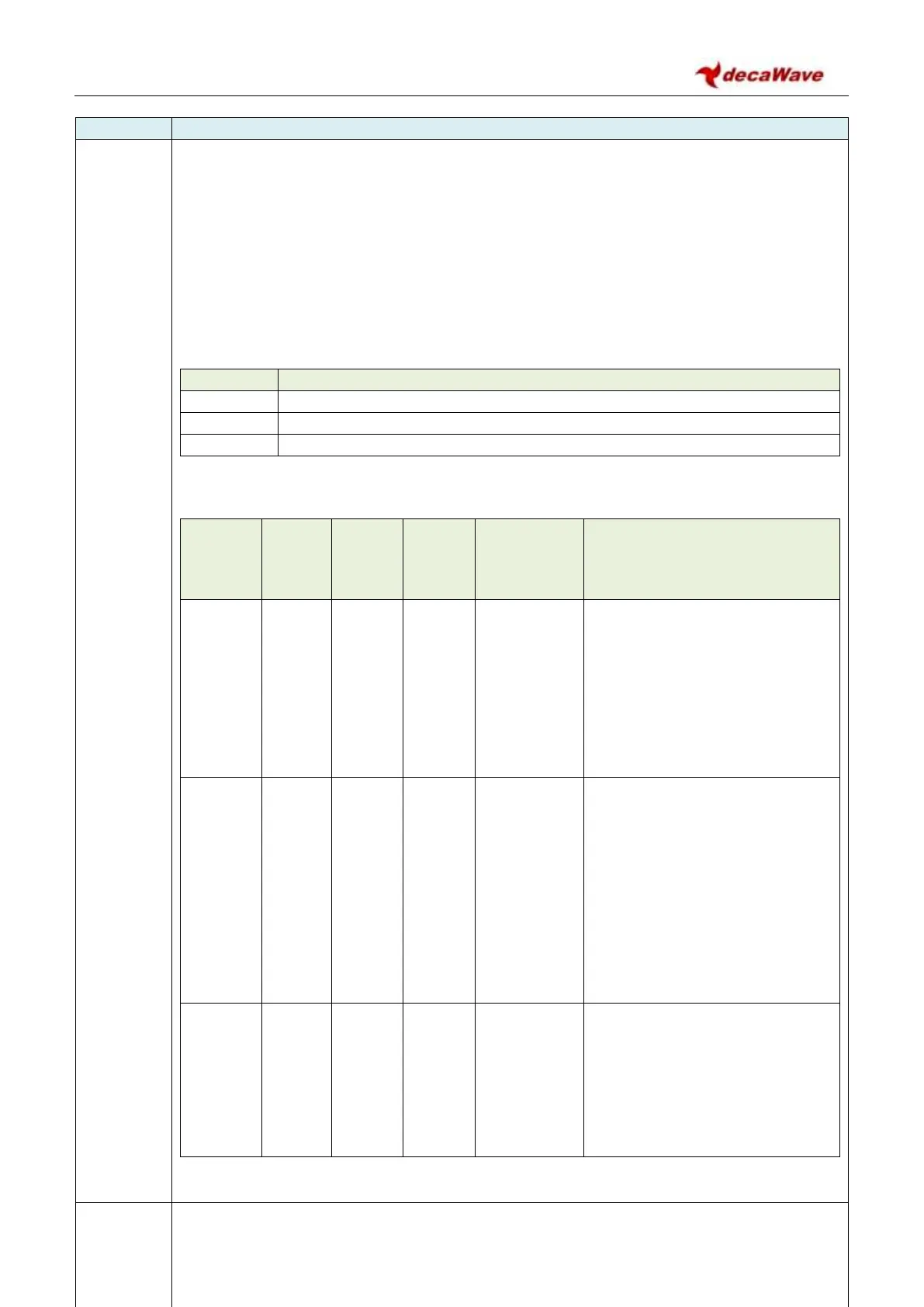
This bit enables a non-standard Decawave proprietary SFD sequence. When DWSFD is 0, and
TNSSFD and RNSSFD are deasserted low, then the SFD sequence used by the DW1000 will be
the one prescribed by the IEEE 802.15.4-2011 standard.
When DWSFD is set a special Decawave-defined SFD sequence will be employed in the
transmitter and looked for in the receiver. For the 110 kbps this SFD is 64 symbols long (as
normal), but for 850 kbps the SFD may be either 8 or 16 symbols long, this is selected by the
SFD length field within Register file: 0x21 – User defined SFD sequence. Other length values are
invalid and should not be used. (For 6.8 Mbps the standard 8-symbol SFD).
The Decawave-defined SFD sequences are as follows:
−−−−−−−+−+−−−−−−+−−+−+−−+−−+−−+−−−++−−−+++−+−+−+−−−+−−+−−−−+++00
For more details please refer to Register file: 0x21 – User defined SFD sequence, and see Table
21: Recommended SFD sequence configurations for best performance
SFD_LENGTH
reg:21:00
bits:0–7
When the DW1000 is operating at
6.8 Mbps, this programming
selects the standard IEEE 8-
symbol SFD which gives sufficient
robustness since the data is
already the weakest part of the
frame.
The standard IEEE 8-symbol SFD is
weaker than data at 850 kbps.
When the DW1000 is operating at
850 kbps, this programming
selects a Decawave defined non-
standard 16-symbol SFD, which
removes the weakness making
the SFD stronger than the 850
kbps data.
This programming selects a
Decawave defined non-standard
64-symbol SFD which is more
robust than standard IEEE 64-
symbol SFD improving the
performance in 110 kbps mode.
Table 22 below presents additional SFD sequence programming options. Note: The selection of
SFD sequences other than the IEEE 802.15.4-2011 UWB standard compliant SFD sequence may
improve performance, but will of course make it impossible to interwork with a device
configured to use the standard defined SFD (or with a third party devices using the standard
SFD).


 To Next Page