Simga2N Traction Advanced Manual– V1.3 Page 91 (166) ©2021 DMC GmbH Herten Germany
Menu 3 “Autotuning”
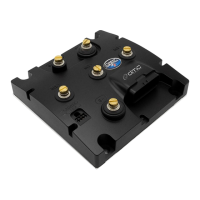
The DMC Simga2NController embeds the possibility to perform an automatic tuning of the motor’s sensor and
parameters. Several feedback sensors can used and auto-tuned: Sin/Cos Encoder, Incremental encoder, Hall sensors
and Resolvers. This feature allows the user to have plug-and-play configuration that ease the usage of the controller. A
small set of data have to be entered for the procedure to be completed.
After initiating the auto tuning, the motor will spin: it is therefore important for the motor to have the possibility to spin
freely. This reflects on traction software in the way that the vehicle must be lifted such that the wheels can rotate freely.
The auto tuning takes from 2 to 10 minutes to complete according to motor technology and autotuning option selected
After a successful auto tuning, all the parameters in the “Menu 4 - Motor setup” will have new values.
Please notice that there is the possibility to change the parameters of the “Menu 3 – AutoTuning” after the autotune
procedure has been completed, but a “Recalculation” procedure must be performed of Autotuning should be run again.
In the next section only general information about the Autotuning feature will be reported. For proper setting
description and more accurate information about Autotuning procedure please refer to the motor technology manual
of interest ([4] for AC, [5] for PMS and [6] for IPM).
Setting up auto tuning
The auto tuning algorithm needs a basic set of parameters in order to get the best results. Usually these values are
printed on the motor name plate or provided on a datasheet. This basic set consists of the following parameters:
*Number of sensor encoder teeth/waves
Set the number of teeth or sine waves per revolution
Sensor encoder supply voltage
Choose 5 volt or 12 volt sensor supply
Reverse the reading speed direction Clock Wise /Counter Clock Wise
Reverse the motor direction assigned to Forward (swap ClockWise/CounterClockWise)
Set the nominal battery voltage
Nominal RMS motor current for autotuning
Set the nominal motor current FOR AUTOTUNING
(suggested 1/3 of motor continuous current for PMS/IPM, Continuous current or S2
60min for AC))
Maximum RMS motor current
Set the maximum required motor current
*Maximum demagnetizing current
If field weakening is required, enter the maximum allowed motor current in field
weakening. Set to 1 to disable. To high values will damage the motor magnets. Consult
motor manufacture first! (ONLY FOR PMS)
Set the motor nominal frequency (FOR AC only)
Maximum desired motor frequency
Set the maximum required motor frequency corresponding to maximum desired speed.
(*) Parameters marked with a star assume different meanings or may not be present at all in some motor
technologies. Please refer to the specific manual of the employed motor technology for details.
Mandatory parameters
Some parameters of the AutoTuning menu are of crucial importance for a proper tuning of motor control.
Maximum motor current
This parameter sets the maximum current that will be injected in the motor when 100% of torque will be required.
It corresponds to the highest current limit for the motor.
After autotuning it is possible to change this parameter if necessary, but a recycle of the key and a “Recalculation”
procedure is required
Maximum motor frequency
This parameter sets the maximum rotor speed and it correspond to 100% of speed.
After autotuning it is possible to change this parameter if necessary, but a recycle of the key and a “Recalculation”
procedure is required
Nominal Frequency and current
This parameters are needed for AC motor technology.


 To Next Page
