SuperSigma2 AM PMS – V1.5.6 17-1-2020 Page 29 (97) ©2019 DMC GmbH Herten Germany
End of Braking parameters examples of different situations
Situation 1: “M3-2T Control Mode “Spd/Torq””= 0 (Speed control mode) and “M3-4T Hill hold ”Off/HH/S””=0
(No Hill Hold)
In this case the controller acts to control the speed and no hill hold is selected, thus the parameters “M1-19T Hill hold
time ”HHTime””, “M1-20T Restraint hill hold speed ”HHspeed”” and “M1-21T Restraint hill hold torque threshold
”HHTrqTH”” won’t be active.
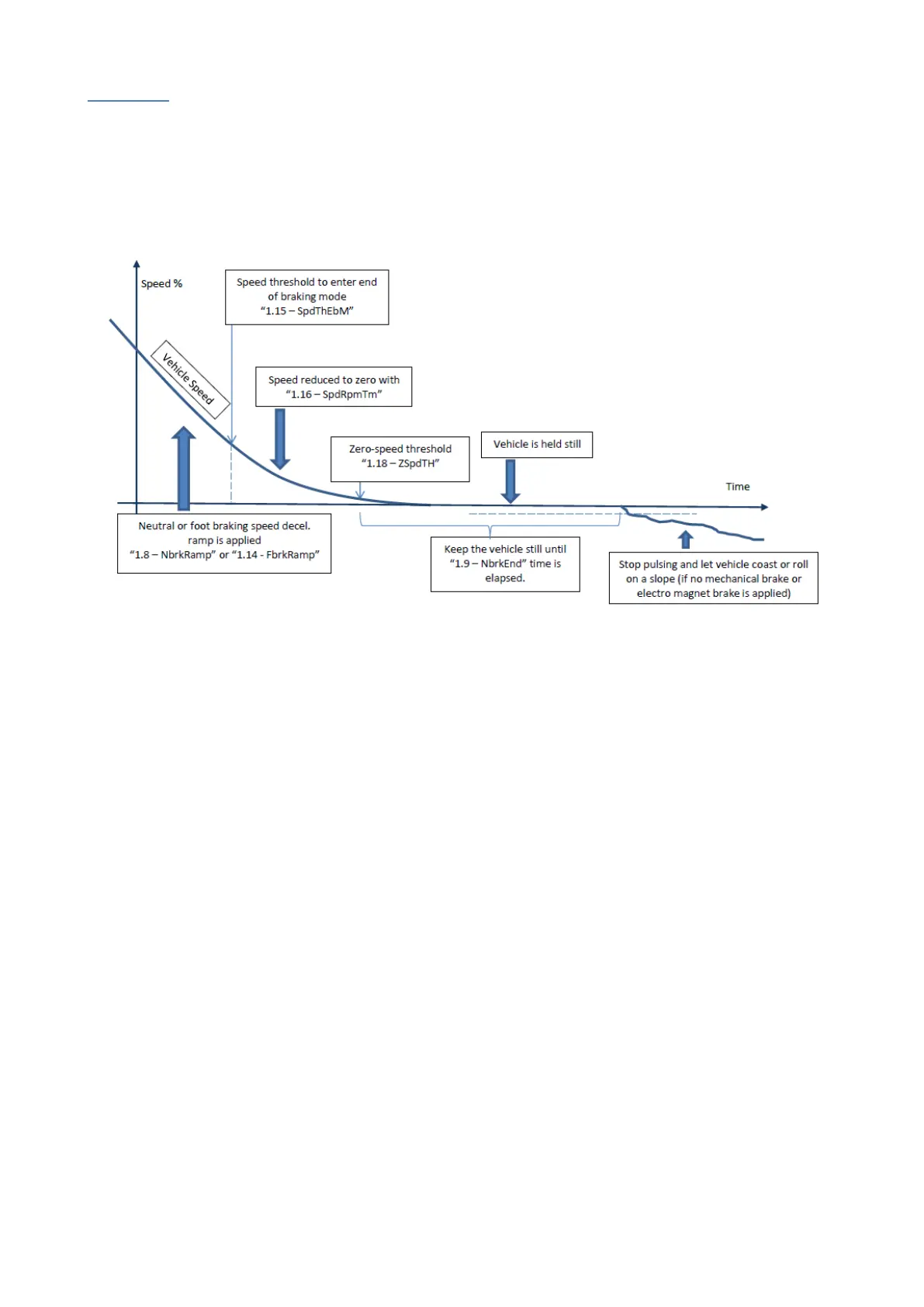
The sequence of operation of the “end of braking” function is represented in the following figure.
End of braking in Speed control Mode and no hill hold
The following list describes the “end of braking” steps:
1. the speed decreases according to “M1-8T Neutral brake ramp time “NBrkRamp”” (if neutral braking is happening)
or “M1-14T Foot brake ramp time “FbrkRamp”” (if foot brake is operated);
2. when speed is below setting “M1-15T Speed threshold to enter end of braking mode ”SpdThEbM””, the
controller reduces speed in a smooth way according to “M1-16T Speed threshold Ramp time to zero speed
”SpdRmpTm””;
3. when speed is below “M1-18T Zero Speed Threshold to enter hill hold or neutral brake end ”ZSpdTh””, the
vehicle is held still until “M1-9T Neutral brake-End delay “NBrkEnd”” time is elapsed. The vehicle is kept still by
means of speed control algorithm;
4. the controller stops pulsing and the vehicle is let coast or roll on slope (if any) unless mechanical brake or
electromechanical brake is applied.
During the end of braking operation, If pedal brake is removed and a direction selected with accelerator pedal demand
(add foot switch in case of ride vehicle) the vehicle will start to move in the selected direction.


 To Next Page