SuperSigma2 AM PMS – V1.5.6 17-1-2020 Page 75 (97) ©2019 DMC GmbH Herten Germany
M7-2 Motor Temp. Cutback start “TempStrt”
This parameter sets the temperature at which the controller starts to cut back the motor current.
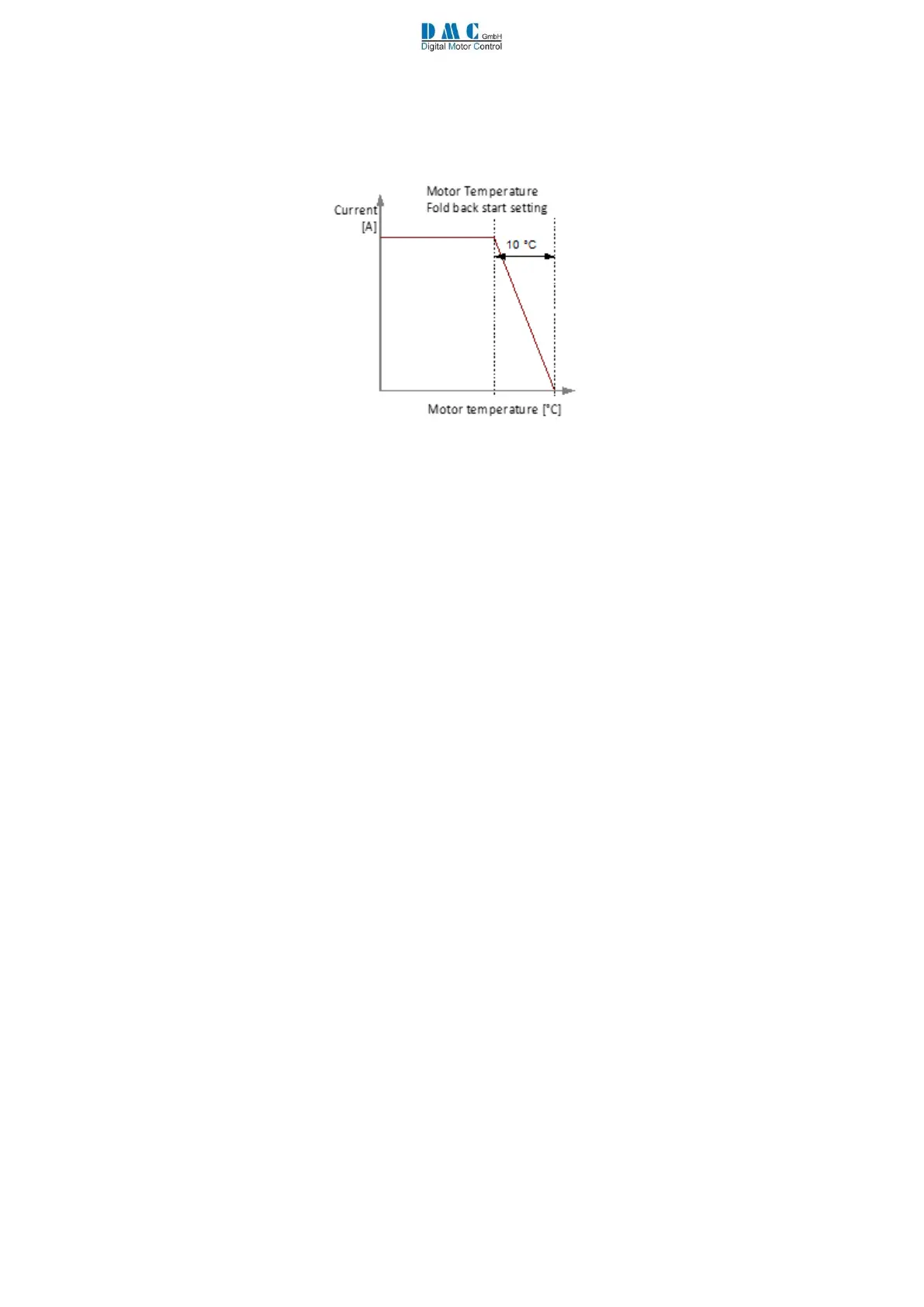
The maximum current value is cut as soon as the motor temperature is above this value and is cut back proportionally to
the temperature between the starting point and 10 °C above it, as shown in the graph below.
As maximum current, the setting “M4-9 Maximum RMS motor current” is considered.
Example:
If the value of “M7-2 Motor Temp. Cutback start “TempStrt”” is 150 °C and the value of “M4-9 Maximum RMS motor
current” is 150A, the current will be limited to 75A when the motor temperature is 155 °C and to 0 when the motor
temperature is 160 °C.
The current cut back is applied only to drive current/torque, thus it does not affect any breaking operation.
Current cut back based on motor temperature can be disabled by setting “M7-2 Motor Temp. Cutback start “TempStrt””
at 151 °C.
M7-3 I²t Nominal Motor Current “NomCurr”
M7-4 I²t Start Motor Temperature “I2tTemp”
M7-5 I²t Time “I2tTime”
M7-6 I²t Cutback1 “I2tCutB1”
M7-7 I²t Cutback2 “I2tCutB2”
M7-8 I²t Cutback3 “I2tCutB3”
These settings are part of I
2
t function (pronounce as “I-squared-t”), that is a current limiting feature: the maximum current
is limited with time.
A detailed description of the function and how to set its parameters is following.
Heat dissipation
When current is flowing through the motor some electrical losses are present (since the motor is not ideal) and they result
in heating up the motor. The heat dissipation is a squared function of the current multiplied by the motor’s resistance, as
shown in the following equation:
The resistance of the motor is a constant factor (although it would increase with a temperature rise). The heat dissipation
will heat up the motor. The longer heat is dissipated, the more the motor will heat up. How fast the motor heats up
depends on the amount of current flowing through the motor. A large current will heat up the motor faster than a smaller
current.
Insulation classes
The heat dissipation results in increasing the motor temperature. The maximum allowable operation temperature of the
motor depends on the insulation class the motor is designed for. The rule here is that there is a ‘temperature rise’ upon
the reference ambient temperature (often 40 °C). Often an allowance for ‘hot spot’ winding is also taken into
consideration (usually 10 °C). This results in the following equation:
When completing this for several insulation classes, it leads to the following table.


 To Next Page