REPLACING OLD SENSOR WITH ORIGINAL
The camshaft position sensor is located on the tim-
ing chain case above the water pump and under the
throttle body (Fig. 1).
If the original camshaft position sensor is to be
removed and installed, such as when servicing the
timing chain, timing gears or timing chain cover, use
this procedure.
(1) Disconnect the sensor harness connector from
the sensor.
(2) Scribe the sensor for location depth.
(3) Remove the sensor mounting bolt.
(4) Carefully pry the sensor from the timing chain
case/cover in a rocking action with two small screw-
drivers.
(5) Remove the sensor from vehicle.
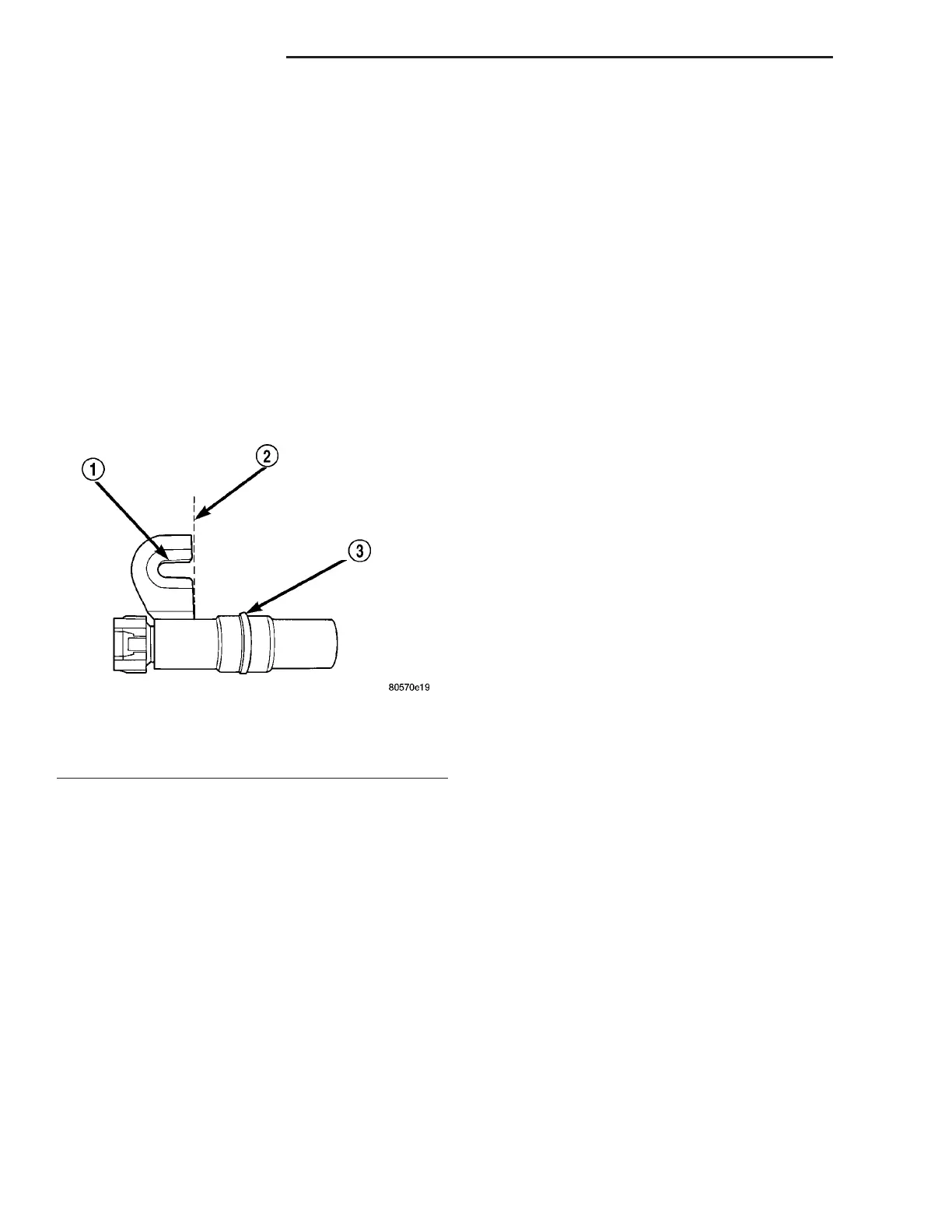
(6) Check condition of sensor o-ring (Fig. 4).
INSTALLATION
INSTALLATION - WITH NEW SENSOR
The camshaft position sensor is located on the tim-
ing chain case above the water pump and under the
throttle body (Fig. 1).
(1) Apply a small amount of engine oil to the sen-
sor o-ring.
A low (step down) and high (step up) area are
machined into the camshaft drive gear. The sensor is
positioned in the timing gear cover so that a small
air gap exists between the face of sensor and the
high machined area of cam gear.
Before the sensor is installed, the cam gear may
have to be rotated. This is to allow the high
machined area (step up) on the gear to be directly in
front of the sensor mounting hole opening on the tim-
ing gear cover.
Do not install sensor with gear positioned at
low area. When the engine is started, the sensor
will be broken.
(2) Using a 1/2 in. wide metal ruler, measure the
distance from the cam gear to the face of the sensor
mounting hole opening on the timing gear cover.
(3) If the dimension is approximately 1–15/32
inches or less, it is OK to install sensor.
(4) If the dimension is approximately 1–5/8 inches
or more, the cam gear will have to be rotated.
(5) Attach a socket to the vibration damper mount-
ing bolt and rotate engine until the 1–15/32 inch
dimension is attained.
(6) Install the sensor into the timing case/cover
with a slight rocking action. Do not twist the sensor
into position as damage to the o-ring may result.
Push the sensor all the way into the cover until the
rib material on the sensor contacts the camshaft
gear.
(7) Install the mounting bolt and tighten to 10.7
N·m (95 in. lbs.) torque.
(8) Connect sensor wiring harness to engine har-
ness.
When the engine is started, the rib material will be
sheared off the face of sensor. This will automatically
set sensor air gap.
REPLACING OLD SENSOR WITH ORIGINAL
The camshaft position sensor is located on the tim-
ing chain case above the water pump and under the
throttle body (Fig. 1).
When installing a used camshaft position sensor,
the sensor depth must be adjusted to prevent contact
with the camshaft gear (sprocket).
(1) Apply a small amount of engine oil to the sen-
sor o-ring.
A low and high area are machined into the cam-
shaft drive gear (Fig. 5). The sensor is positioned in
the timing gear cover so that a small air gap exists
between the face of sensor and the high machined
area of cam gear.
Before the sensor is installed, the cam gear may
have to be rotated. This is to allow the high
machined area on the gear to be directly in front of
the sensor mounting hole opening on the timing gear
cover.
Do not install sensor with gear positioned at
low area (Fig. 6). When the engine is started,
the sensor will be broken.
(2) Using a 1/2 in. wide metal ruler, measure the
distance from the cam gear to the face of the sensor
mounting hole opening on the timing gear cover.
(3) If the dimension is approximately 1–15/32
inches or less, it is OK to install sensor.
(4) If the dimension is approximately 1–5/8 inches
or more, the cam gear will have to be rotated.
Fig. 4 Camshaft Sensor O-Ring
1 - SLOTTED MOUNTING HOLE
2 - SCRIBE LINE
3 - CAMSHAFT POSITION SENSOR O-RING
8I - 4 IGNITION CONTROL ZB
CAMSHAFT POSITION SENSOR (Continued)











 To Next Page