34
PDF/VT Support
Efficiently driving complex VDP jobs in digital print requires support for multiple standards to ensure interoperability. Fiery servers are
compliant with PDF/VT, a new standard developed by the ISO for VDP data exchange, through both CPSI and APPE. Supporting
PDF/VT brings the benefits of a PDF workflow to VDP, helping print providers increase production efficiency with capabilities such as late-
stage exchange of critical variable content.
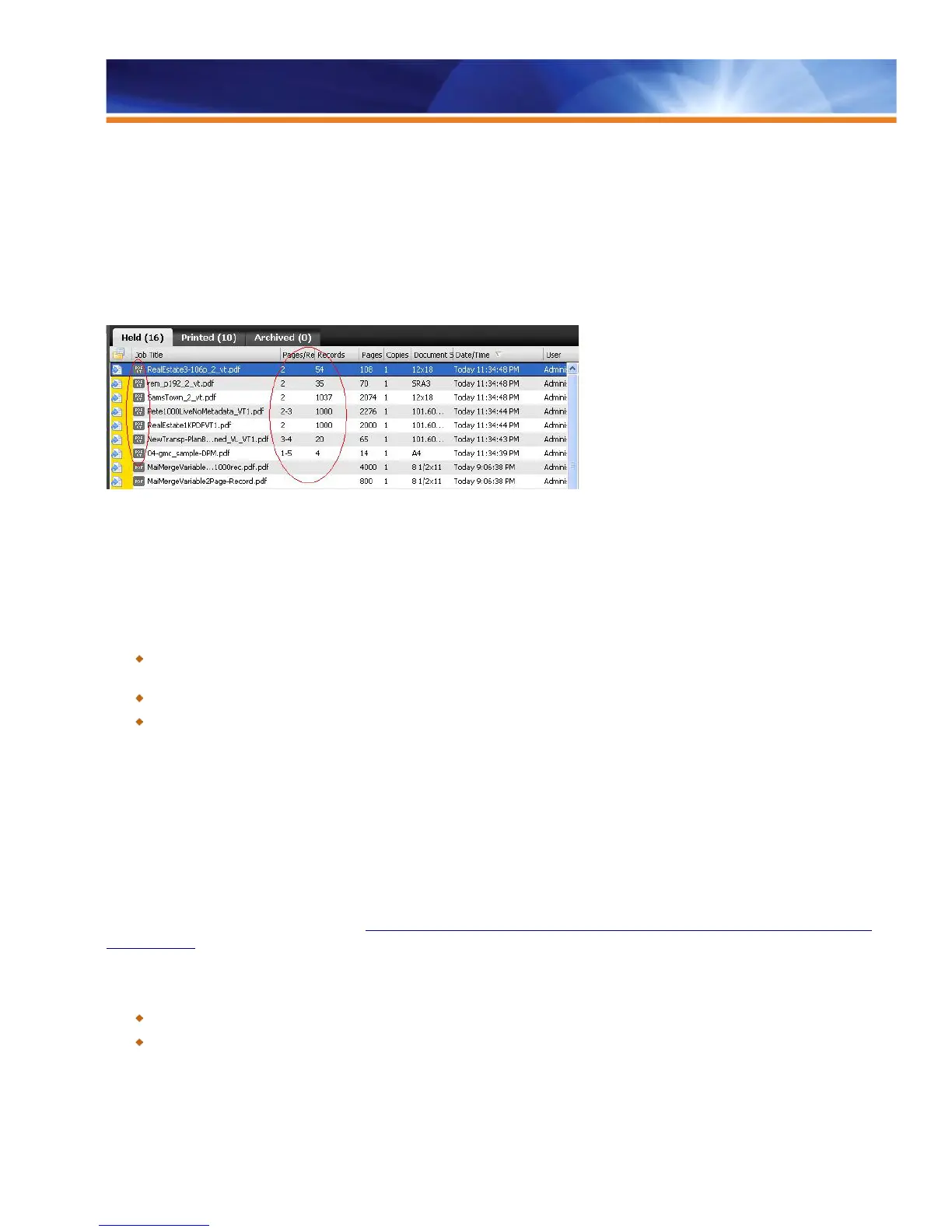
The system processes PDF/VT files the same way it handles other VDP files — by detecting records defined in the PDF/VT job and
caching reusable XObjects — and displays a format icon for PDF/VT jobs on the Fiery Command WorkStation.
The format icon, as well as the quantity of records and pages per record, identifies PDF/VT jobs in the Command WorkStation
PDF/VT enables high-performance rendering of graphically rich content for printing on high-speed digital presses by caching repeated text
and graphics. A significant number of products that will create or consume PDF/VT are currently in active development and will likely be
introduced in the near future.
Benefits:
Folds seamlessly into existing PDF-based prepress operations, enabling a single common PDF print production workflow for all
job types.
Easier to use, with a visual illustration of cached, reusable elements and easy identification of VDP jobs.
Increases productivity with support of users’ existing workflow.
PDF/VT-2 Support
PDF/VT is Adobe’s variable data language, based on PDF technology. PDF/VT-1 support was introduced in Fiery System 10 servers, and
PDF/VT-2 is now supported on Fiery servers running FS100 Pro and FS150 Pro. The Fiery server recognizes the new PDF/VT file type
and shows a different icon in Command WorkStation for this format. It automatically extracts the records information and displays the
number of records and pages per record, showing PDF/VT cached resources in the VDP Resource Manager. PDF/VT is supported for
both CPSI and APPE interpreters. PDF/VT-2 gives users a performance improvement because PDF/VT files can refer to resources
through a file search path so that they can be processed inline, but the overall PDF/VT file size being transferred is reduced.
With PDF/VT-1, all of the resources had to be contained inside the file.
See this Adobe whitepaper for more details:
Benefits:
http://www.pdf-tools.com/public/downloads/whitepapers/Whitepaper-PDFVT-Standard-ISO-
16612-2-EN.pdf
Supports the latest VDP standard so that operators can confidently print any standard VDP data stream.
Adds flexibility to customer workflows.


 To Next Page