19
String Sizing
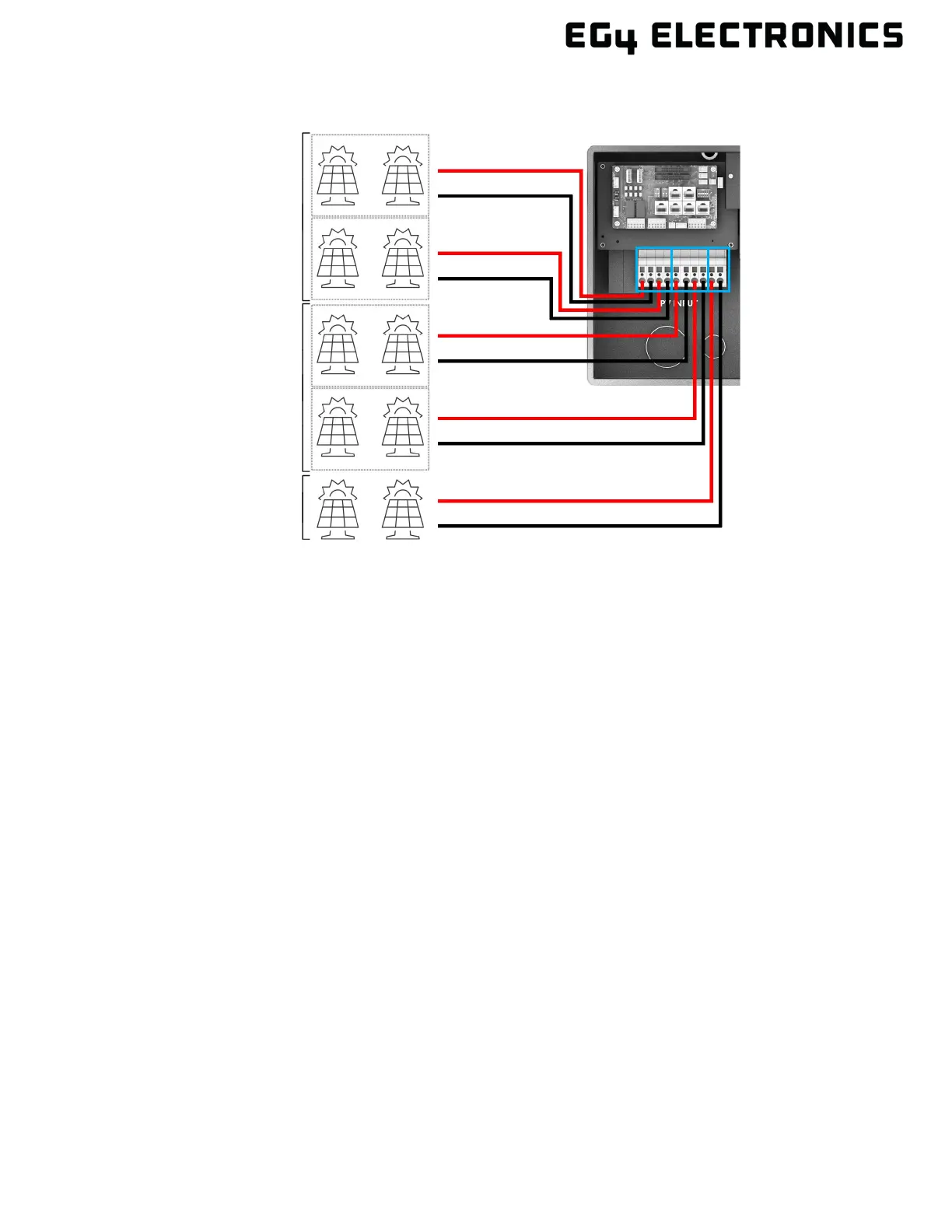
• Each string should ideally contain the same model, brand, and quantity of panels for ease of
design, racking, and wiring. However, varying string sizes can be used for unique MPPTs. If
two strings are used for MPPT1, they MUST be the same model, brand, and number per
string. MPPT2 and MPPT3 could differ in model, brank, and number per string (same
make/model per string) on the condition that each string complies with the lowest
temperature (maximum string number) and maximum amperage calculations.
• When solar modules are put in a series string, the voltage multiplies by the number of
modules and the amperage stays the same as each module.
• Calculate the maximum current of the string so as not to exceed the inverter’s MPPT circuit
ratings. Double check if the calculated VMP range is within the 120 – 440VDC optimal MPPT
circuit operating range. Consult a solar designer if needed.
• When solar modules are put in parallel, the amperage multiplies by the number of modules
and the voltage stays the same as each module.
• The inverter has three MPPT inputs: MPPT1 and MPPT2 will use up to 26 amps each which
means strings can be paralleled together for any modules having less than a 13A (Imp)
rating, ensuring the total amperage does not exceed 26A. MPPT #3 will use up to 15 amps
which means strings can be paralleled together for any modules having less than 7.5A (Imp),
ensuring the total amperage does not exceed 15A.
• All panels on a series/parallel string should face the same orientation and hopefully be
exposed to roughly the same shading across the string. Consideration should be placed on
string location and wiring order on the racking to minimize shading effects. One shaded
module can disproportionately reduce output for the entire string, so avoiding linear strings in
favor of rectangular strings can increase output. Optimizers can also achieve this.
• The total maximum solar input power of the inverter is 21kW


 To Next Page