Enertech Global
EAV - EME/EMD Rev. A Models
Installaon and Operaons Manual
It is important that the load side piping of the EAV system is
sized properly for the required ow rates and is ushed and
lled with good quality water and treatment. This will help
ensure that the longevity of the pump(s), braze plates, and other
load side components.
The Wye Strainer, which contains a #40 mesh, will collect debris
le in the piping aer the system has been ushed and lled.
Per the installaon diagrams shown in
boiler drains and isolaon valves need to be integrated into the
load piping for proper ushing of the system at start up, as well
as for future service. Full port isolaon valves should be used in
order to ensure low pressure drop throughout the system.
Generally, the recommended load side piping arrangement
is designed as a parallel direct return system. Each zone is in
parallel and returns directly to the heat pump. Zone valves
should be ulized on each circuit to control the soluon ow
to each manifold/zone/circuit or distribuon device. Enertech
recommends zone valves have a CV rang of 8.9 or higher to
help guarantee proper ow and low pressure drop throughout
the system. All zone valves must be on/o style valves. If it is
determined that any of the zone’s ow rates are less than 5
GPM, a pressure dierenal bypass valve is required for proper
unit operaon (Enertech P/N: ADBV4A).
CAUTION
THIS SYSTEM UTILIZES A PRESSURIZED LOAD CIRCUIT. PLEASE ENSURE THE FOLLOWING:
1. The load side piping is flushed completely and purged of air (see Secon 6, Figures 7a to 7j).
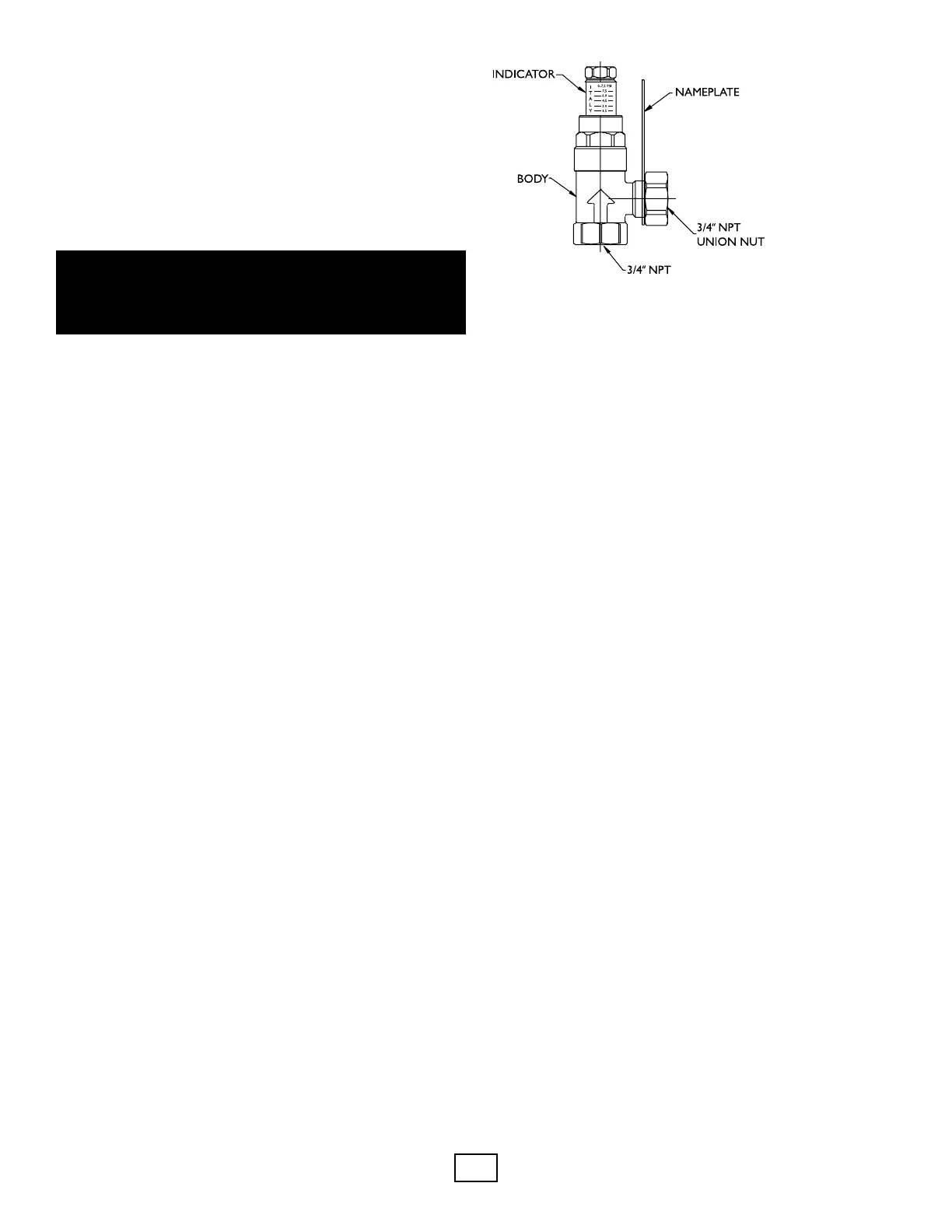
2. The differenal bypass valve is installed, and in the correct orientaon (see page 16 and
drawing below).
3. The minimum pump speed is set to allow 5 GPM through the bypass valve
with all zones closed (see page 16) if hydraulic separator or buffer tank is not
used (a hydraulic separator or buffer tank is recommended).
NOTICE: A flush cart is required for purging air from the load side piping. See WV I.O.M.,
Figures 6a to 6c for valve arrangement and Secon 6 (Flushing and Filling) for flushing steps.
Remove this page from the manual before providing to building owner.
3. The minimum pump speed is set to allow 5 GPM through the bypass valve
with all zones closed (see page 16) if hydraulic separator or buffer tank is not
used (a hydraulic separator or buffer tank is recommended).
Referencefor installaon of a bypass valve.
Follow the steps below for valve sengs.
1. The bypass valve seng should be adjusted during the
Startup Wizard in when seng the minimum
pump speed (manual mode).
2. Set the adjustment indicator at 4.5 on the bypass valve.
3. In the Startup Wizard, start with the default minimum pump
speed at 60%. Open the zone valve for the smallest zone
(lowest ow rate). It will be important to know the design
ow rate for the smallest zone. For example, if the smallest
zone has 5 - 1/2” PEX circuits, the design ow rate is
typically 2.5 to 4 GPM. The combinaon of the minimum
pump speed and the bypass should provide a minimum for
5 GPM.
4. Turn the adjustment indicator counter-clockwise to allow
the combined ow of the smallest zone and the bypass
valve to equal 5 GPM. The minimum pump speed may need
to be adjusted to higher than 60%, depending upon the size
of the zone.
An automac air eliminaon device and expansion tank are
factory installed in the indoor unit. They help remove any micro-
bubbles sll remaining aer purging and lling. The expansion
tank maintains minimum pressure in the hydronic system for
proper pump operaon.
Most local codes require certain components be installed within
the system. Local codes should be followed when determining
the exact requirements. A pressure relief valve may be required,
which should be rated for 30 PSI and terminated 6” from the
oor surface. Addionally, back-ow preventer may be required
and should be installed if a make-up water line is connected
from the water source to the load side piping of the system.
Even if a back-ow preventer is not required, it is highly
recommended.
⚠⚠
All interior piping must be sized for proper ow rates and
pressure loss. Insulaon should be used on all inside piping
when minimum temperatures are expected to be below the dew
point (less than approximately 50°F). All pipe insulaon should
be made of closed cell and have a minimum wall thickness
of 3/8” for interior piping. Piping between the Outdoor Unit
and the Indoor Module should be at least 3/4” wall thickness.
All piping insulaon should be glued and sealed to prevent
condensaon and dripping. Interior piping may consist of the
following materials: PEX, copper, or stainless steel hose (hose kit
only). PVC and other piping types are not recommended.



 To Next Page