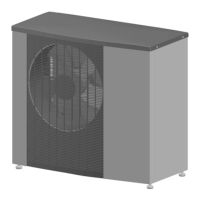
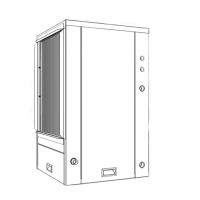
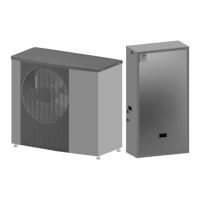
Enertech Global
EAV - EME/EMD Rev. A Models
Installaon and Operaons Manual
The EEV modulates as needed to maintain 8°F superheat. Above
the setpoint causes the EEV to open and below causes it to
close. The EEV remains completely closed when the system is
idle. Movement of the valve can be observed on the LEDs of the
driver in the lower control box.
: In some condions it is normal for the EEV to open 100%
and the superheat to be above 8°F.
The EAV outdoor unit has a built-in defrost control that monitors
air coil temperature, outdoor air temperature, run me,
compressor RPM, and operaon mode. In the heang or DHW
mode, there are two types of defrost cycles, acve defrost and
passive defrost.
If the outdoor temperature is above 39°F and the compressor is
not operang but the air coil temperature indicates that defrost
is necessary, passive defrost starts. In passive defrost mode,
the reversing valve does not shi. The fan runs at high speed
to aempt to increase coil temperature with the outdoor air
temperature. If there is a compressor demand, passive defrost
stops and the compressor starts. Acve defrost may be enabled,
depending upon coil temperature when the compressor is
running.
Acve defrost mode starts when the air coil temperature
(thermistor BT16) falls below 27°F. Acve defrost can occur as
infrequently as once every 12 hours (for calibraon purposes)
or as oen as once every 90 minutes, depending upon coil
temperature, outdoor air temperature, and amount of moisture
in the air. Time unl “acve defrosng” is shown in minutes
on the indoor module HMI display. During acve defrost, the
reversing valve shis to cooling mode, the fan stops, and the
compressor connues to run unl the coil temperature (BT16)
reaches 37.4°F or the discharge gas temperature reaches 140°F.
Defrost mode connues for 90 seconds once either temperature
is reached.
If the unit is unable to nish an acve defrost cycle ten mes in
a row (there is no me limit), an alarm will be displayed, and the
control will not aempt to operate the compressor. The power
must be cycled to reset the unit. There are several possible
reasons for an unsuccessful defrost, as follows:
1. When defrosng has gone on for longer than 15 minutes.
This may be due to a strong wind eect on the air coil. A
wind shield may be necessary.
2. When the water/anfreeze temperature on the line
entering the outdoor unit (thermistor BT3) falls below 50°F.
3. If the temperature of the air coil connues to drop.
Insucient airow through the air coil or insucient water
ow to the outdoor unit should be inspected and checked if
it is unable to complete a successful defrost. If the unit has
a signicant amount of leaves around the air coil or if the
coil needs cleaning, the coil may not be able to transfer heat
properly. Insucient water ow is generally due to a pump
failure and should be displayed as a water ow fault at the HMI.
If the air coil is too cold, a “safety defrost” starts. This defrost
cycle can be started earlier than a normal acve defrost. If there
are ten safety defrost cycles in a row (there is no me limit),
an alarm will be displayed, and the control will not aempt to
operate the compressor. The power must be cycled to reset the
unit.
Defrost may be acvated manually for service or tesng
purposes. A toggle switch is located in the “Manual Control”
menu at the HMI.
Work behind covers secured by screws.
As EAV can be connected to a large number of external
units, these should also be checked.
In the event of acon to recfy malfuncons that require
work within screwed hatches the incoming electricity must be
disconnected at the safety switch.
The alarm is acknowledged on the EME/EMD module or
by the voltage to the heat pump being interrupted and then
restarted.
The following ps can be used to recfy comfort issues:
Low hot water temperature or a lack of hot water:
This part of the fault-tracing secon only applies if the heat
pump is connected to the hot water heater.
• Large hot water consumpon.
- Wait unl the hot water has heated up.
• These sengs are made on the display on the indoor
module/control module.
- See the secon for the indoor module or control module.
• Clogged strainer.
- Check whether alarm “high condenser out” (162 is an
informaon message. Check and clean the strainer.
• Thermostats o in several rooms.
- Set the thermostats to max in as many rooms as possible.
• Zone panel is not showing heang/cooling calls.
- Check sengs.
• Incorrect sengs in indoor module or control module.
- See the manual for the indoor module / control module
(EME/EMD Series).
• Incorrect ow across the heat pump.
- Check whether alarm “high condenser in” (163) or
“high condenser out” (162) are info messages. Follow the
instrucons for adjusng ow rate.
EAV communicates all alarms to the indoor module/ control
module (EME/EMD Series).
• Ensure that the EAV is connected to the power source and
that compressor operaon is required.
• Check the indoor module/control module (EME/EMD
Series). See Indoor Module secon in this manual.
• Check that the addressing of EAV is correct.
• Check that the communicaon cable has been connected.
Ice build-up in the fan, grille and/or fan cone on the outdoor
module
• De-icing fan is not acvated.
- Acvate “de-icing fan” (menu 5.11.1.1).



 To Next Page