IP Server 900 Programming Manual Function 3: Station programming
F.31
ACD
ACD department programming
ACD departments can be programmed to route calls based on several optional parameters. Each ACD
station can be logged onto as many as two ACD departments at the same time. Also, each ACD station can
be a member of up to 20 ACD departments (i.e., up to 20 log-on keys may be assigned to each ACD station.)
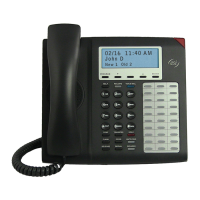
Each ACD agent must have a ESI digital phone, ESI desktop IP phone, ESI Digital Cordless Handset (II
or “I”), or VIP 7 Softphone. Agent log-on keys will be automatically assigned to the lower left programmable
feature keys for the stations listed in ACD departments (with wrap keys automatically assigned above
them; see “Feature keys,” page F.42).
Note: Line keys can’t be used to answer calls ringing Attend departments set in the live-ring list (in
Functions 211, 2121, 2131, and 2141).
ACD overflow
Incoming calls that are holding (queued) for an available agent can be automatically forwarded to a new
destination if ACD overflow is assigned. ACD overflow can be initiated by exceeding a maximum number of
queued calls or by an individual exit timer set for each ACD department. If ACD overflow parameters aren’t
assigned, the default action will be to overflow calls based on the system default ACD exit timer only.
ACD overflow parameters are:
• Queue exit threshold — If the number of calls in queue matches a predetermined queue exit
threshold, all subsequent calls to that ACD department will immediately follow that department’s
call-forward destination.
• ACD exit timer — When a call has been held in queue for a predetermined duration specified for that
ACD department, the call will follow the department call-forward destination. If the department’s ACD
exit timer isn’t assigned, the system-wide default (for the current operation) will be used.
ACD agent priority
ACD agents who are simultaneously logged into two departments can have calls to one department take
precedence over the other department’s calls. When the ACD station is assigned to each ACD
department, the “baseline” priority is set for calls that are directed to that station from that department.
ACD call escalation (priority override)
An incoming call that has been in an ACD department queue the longest can be forced to ring at the next
available agent, regardless of the priority setting of that agent’s station department log-in.
A timer that’s set in ACD department programming (see page F.32) triggers this ACD escalation.
Note: Usually a caller will be forwarded to a department by the auto attendant. However, a user, too, can
transfer a caller to the department number. The transferred call will be processed according to the
above description, as if transferred by the auto attendant. If no agents are logged-on to an ACD
department, incoming calls will immediately follow the department’s call-forwarding setting.


 To Next Page