The FRAMOS Industrial Depth Camera D400e Series are advanced depth cameras built with Intel® RealSense™ technology, designed for robust performance in industrial environments. These cameras are ideal for OEMs and integrators requiring both 3D and 2D vision capabilities in their products and applications. The D400e Series is compatible with the cross-platform Intel® RealSense™ SDK 2.0, offering support for multiple programming languages, wrappers, sample code, and tools.
Function Description
The D400e Series cameras utilize stereo vision depth technology to calculate depth. This involves a left imager, a right imager, and an optional infrared projector. The infrared projector enhances depth accuracy in scenes with low texture by projecting a non-visible static IR pattern. Both imagers capture the scene and send image data to an onboard vision processor (Intel® RealSense™ Vision Processor D4), which calculates depth values for each pixel by correlating points between the left and right images. The processed depth pixel values then generate a depth frame, forming a continuous depth video stream.
The D400e Series includes various models: D415e, D435e, and D455e. The D435e and D455e models feature global shutter sensors and wide fields of view, making them particularly suitable for applications involving fast motion. The D415e model uses a rolling shutter.
Important Technical Specifications
General:
- Data Transmission: Gigabit Ethernet, up to 100m in length.
- Power & Data: Single cable solution via Power over Ethernet (PoE).
- Data Reliability: Increased transmission reliability with packet resend functionality.
- Depth Calculation: Onboard, using Intel® RealSense™ Vision Processor D4.
- Environmental Protection: IP66 dust and water-proof housing for industrial environments (IP67 on project basis).
- Connectivity: Secure cable connections with threaded M12 (Ethernet) and M8 (Power/I/O) plugs.
- Synchronization: External event synchronization.
- Simultaneous Streaming: Depth and RGB streaming at profiles like 1280 x 720 @ 30fps.
Depth Modules:
- D415e: Intel® RealSense™ Depth Module D410 (55mm baseline, standard imagers).
- D435e: Intel® RealSense™ Depth Module D430 (50mm baseline, wide imagers).
- D455e: Intel® RealSense™ Depth Module D450 (95mm baseline, wide imagers).
- Depth Resolution: 1280 x 720 px (rolling shutter for D415e, global shutter for D435e/D455e).
- Operating Range: 0.2m - 10m for D415e/D435e, 0.3m - 20m for D455e.
- Minimum-Z Depth (1280x720): 450mm (D415e), 280mm (D435e), 520mm (D455e).
Imagers:
- D415e (Left/Right): OmniVision OV2740, 1920 x 1080 active pixels, 10-bit RAW, f/2.0, 1.88mm focal length, rolling shutter.
- D435e (Left/Right): OmniVision OV9282, 1280 x 800 active pixels, 10-bit RAW, f/2.0, 1.93mm focal length, global shutter.
- D455e (Left/Right): OmniVision OV9272, 1280 x 800 active pixels, 10-bit RAW, f/2.0, 1.93mm focal length, global shutter.
Infrared Projector:
- Type: Static, vertical-cavity surface-emitting laser (VCSEL) + Optics.
- Laser Wavelength: 850nm ± 10 nm nominal @ 20°C.
- Laser Compliance: Class 1, IEC 60825-1:2007 Edition 2, IEC 60825-1:2014 Edition 3.
Color Sensor:
- D415e/D435e: OmniVision OV2740, 1920 x 1080 active pixels, 10-bit RAW RGB, f/2.0, 1.88mm focal length, rolling shutter.
- D455e: OmniVision OV9782, 1280 x 800 active pixels, 10-bit RAW RGB, f/2.0, 1.88mm focal length, global shutter.
Inertial Measurement Unit (IMU):
- Sensor: Bosch BMI055 6-axis inertial sensor.
- Degrees of Freedom: 6.
- Accelerometer Sample Rate: 62.5, 250 (Hz).
- Gyroscope Sample Rate: 200, 400 (Hz).
Physical Interfaces:
- Ethernet: M12 connector, X-Coded, Female (1000BaseT, 802.3 compliant).
- Power/I/O: M8 connector, A-Coded, Male (12-24V DC power supply, opto-isolated IN/OUT, GND).
Dimensions (LxHxW):
- D415e/D435e: 100mm x 47mm x 38mm.
- D455e: 132mm x 47mm x 41mm.
Weight:
- D415e/D435e: 250 grams.
- D455e: 395 grams.
Power Consumption:
- Via M8: Max 7W.
- Via M12 (PoE): Max 8W.
Depth Quality Specifications (up to 2m/4m and 80% ROI, HD Resolution):
- Z-accuracy (absolute error): ±2%.
- Fill rate: ≥ 99%.
- RMS Error (Spatial Noise): ≤ 2%.
- Temporal Noise: ≤ 1%.
Usage Features
Software Compatibility:
- FRAMOS Camera Suite SDK: Provides API, GigE Vision filter driver, sample code, and tools for configuration and image acquisition.
- Intel® RealSense™ SDK 2.0: Modified version included, offering Intel® RealSense™ Viewer, Depth Quality Tool, Debug Tools, Code Examples, and Wrappers for various programming languages (ROS, Python, Matlab, node.js, LabVIEW, OpenCV, PCL, .NET).
IP Configuration:
- ConfigureIP Tool: Used to set Persistent IP, DHCP, or LLA (Link-Local Address) configurations. Supports interactive and non-interactive modes.
Firmware Updates:
- UpdateFirmware Tool: Allows interactive and non-interactive firmware updates for single or multiple cameras. Supports parallel firmware updates for compatible devices.
Camera Calibration:
- CalibrationTables Tool: Manages calibration tables, allowing users to read, write (active or active + gold), and reset calibration tables to default factory settings.
Thermal Control:
- Operating Temperature: Max 60°C on the back side of the camera housing.
- Heat Dissipation: Designed for optimal thermal coupling with external dissipative elements (e.g., metal camera holders or heatsinks) via threaded mounting holes. Thermal paste is recommended for maximum conductivity.
Synchronization Modes:
- Inter Cam Sync Mode: Supports Default, Master, Slave, Genlock (for global shutter cameras), External Event, and External Event Burst modes for synchronous streaming of multiple cameras or synchronization to external events.
- Syncer Mode:
RS2_SYNCER_MODE_DEFAULT (original librealsense2 syncer) and RS2_SYNCER_MODE_WAIT_FRAMESET (for external events, returns synchronized frameset only when all enabled streams have arrived).
Output Trigger and User Output:
- Output Trigger Enabled: M8 Pin 3 drives the VSYNC synchronization signal in all Inter Cam Sync modes.
- User Output Level: When Output Trigger is disabled, M8 Pin 3 can be set to low or high voltage for controlling external lighting or other devices.
Line Debouncer Time:
- Configurable minimum interval (in microseconds) for input signals on the digital input pin to be recognized as valid, preventing unwanted trigger events from short pulses or noise.
RGB/Stereo Synchronization:
- Achieved by setting Inter Cam Sync Mode to "Default Mode" or "External Event Mode," disabling RGB Auto Exposure Priority, and matching RGB and Stereo framerates.
Maintenance Features
Cleaning Procedures:
- Camera Housing: Clean with a soft camera cleaning brush or a soft cleaning cloth.
- Camera Window: Use an eyeglass cleaning cloth. Avoid abrasive materials to prevent scratches. Ethyl alcohol can be used for light wiping of the entire camera housing. Strong solvents are not recommended.
Troubleshooting:
- Refer to the FRAMOS RealSense Cameras Knowledge Base for problem resolution.
Regulatory Compliance:
- Laser Safety: Classified as Class 1 Laser Product under EN/IEC 60825-1, Edition 3 (2014) and IEC60825-1, Edition 2 (2007) in the US. Complies with US FDA performance standards under 21 CFR 1040.10.
- WEEE: Must be disposed of at designated collection points for recycling.
- Other Certifications: CE, FC, RoHS.
- Shock: DIN EN 60068-2-27.
- Vibration: DIN EN 60068-2-6, DIN EN 60068-2-64.
Important Cautions:
- Do not power on if external damage is observed.
- Do not attempt to open any portion of the laser product.
- Avoid direct exposure to invisible laser radiation when opened.
- No user-serviceable parts.
- Modification of the stereo module (especially the infrared projector) may cause emissions to exceed Class 1.
- No magnifying optical elements are allowed.
- Only use officially released firmware updates for specific camera modules and revisions.
- Ensure correct connection, position, and orientation of RGB and Depth Interposer cables to the FRAMOS D4 Visual Processing Board to prevent permanent damage.
- Use metal camera mounts to assure optimal heat conductivity and avoid plastic mounts.
- Minimize resource utilization (fps, exposure, projector intensity) to positively affect heat generation and product longevity.
- If overheating is an issue, supply power via the M8 connector rather than PoE.

 Need help?
 General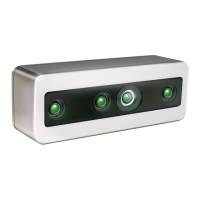

 To Next Page