Technical Support is available from 8am to 5pm (PST) M - F at support@fslaser.com.
62
SECTION VII. OPERATIONS
This section will guide you through using your Muse laser cutter. To get started, it is important to
understand the meanings of “Vector Cutting” and “Raster Engraving” and their associated le types.
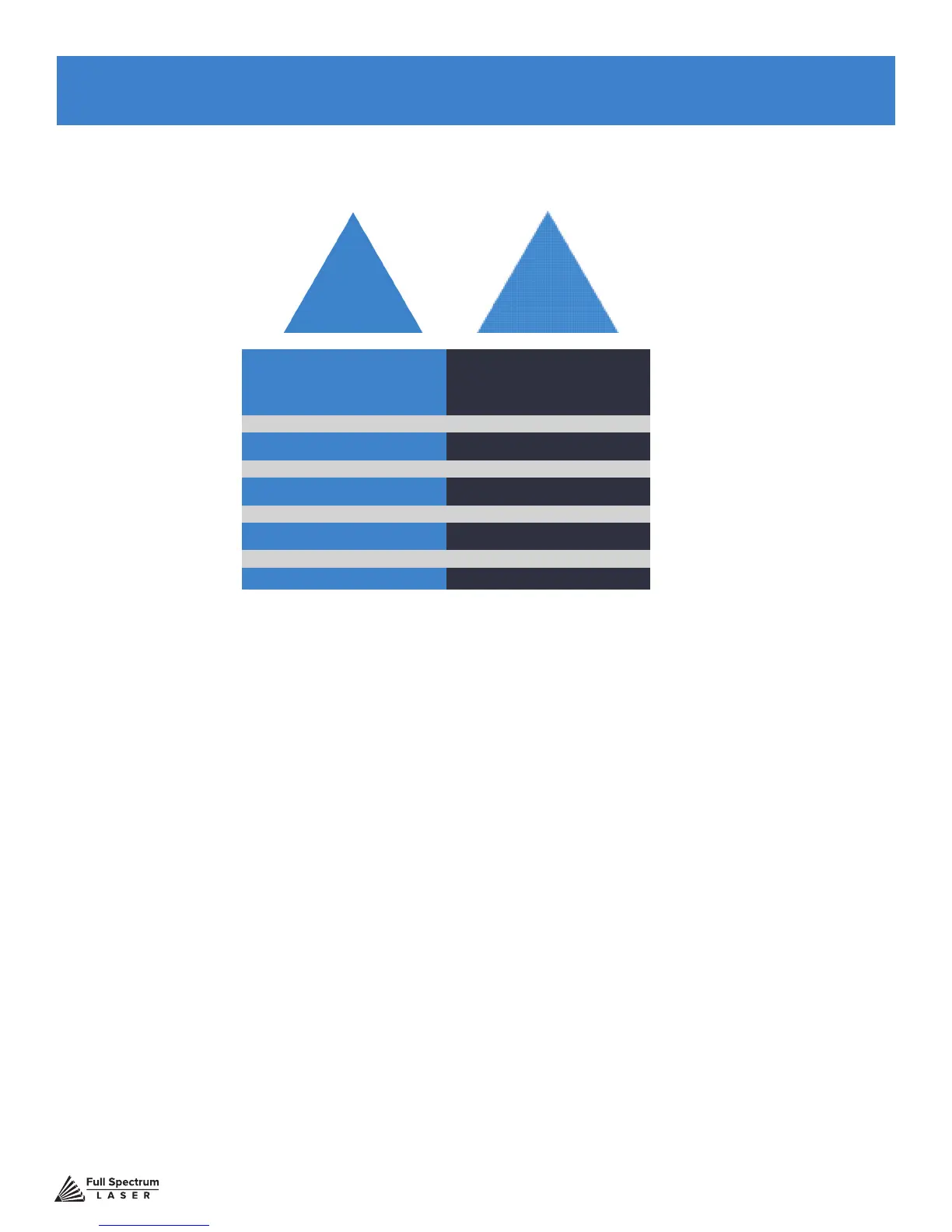
RASTER
Project Examples
File Types
Preferred File Type
File Composition
VECTOR
PDF, SVG
Signs, Logos, Parts, Gears
PDF
Geometric Formulas
JPEG, GIF, PNG, TIF
Image Engraving, Surface Marking
JPEG
Pixels
General Functions
Vector Cutting
Vector cutting is the most common feature of a laser cutter. Vector cutting with a laser means “to cut a
line or shape”. When vector cutting, the laser follows the “vector lines” embedding in the vector image
to cut out the design. The laser starts at a designated location and follows the vector lines until the
shape is cut out. This process is highly accurate and requires no resolution adjustments because of
the properties of a vector image.
Vector Images
In Vector Cut mode, the software receives information from the print stream and interprets it as a
series of paths for the laser head to follow. For the print stream to have vector information, the le
being printed must be a vector image. Vector images are more exible than raster images. These
images are created using mathematical equations rather than pixel blocks. PDF’s work great as
vector les and are easy to resize without losing resolution. Company logos and branded graphics
are usually vector images.
Engraving
Engraving is the process by which complex designs are etched into a workpiece. Engraving
can range from a simple surface mark all the way through deep material removal. Engraving is
differentiated from cutting in that cutting is the process of burning a closed contour completely
through a workpiece. Engraving is also known as “Raster Engraving” or “Rastering”. For engraving,
a laser has two states: on and off. Every black pixel or “laser dot” is the result of the laser turning on
and ring at that location. This location is controlled by the input image, which can be thought of as a
Figure 7.1


 To Next Page