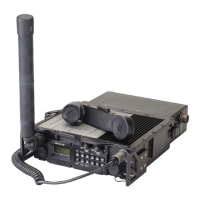
General Dynamics C4 Systems URC-200 (V2)
48
Table 9 - Remote Responses
CODE NAME DESCRIPTION
Response from the transceiver to a valid RCU command. If the
command requires data from the transceiver, the data is sent first,
Response from the transceiver to an invalid RCU command.
acknowledge
A response from the transceiver indicating that the transceiver was
in the keypad (manual) command mode at the time it received a
remote command. The transceiver changes mode to the remote
command mode and sends HT. This acknowledge is used instead
of an ACK for the first valid remote command received when
transceiver was in keypad command mode.
The RCU cannot send a new command until it receives an ACK/NAK/HT or times out, whichever
occurs first. If the RCU receives a NAK or times out, send the Z command to re-establish sync with
the transceiver.
Provisions must be made on the RCU side to poll the status of the transceiver especially in the
over-temp, scan, and synth lock conditions. Another provision that the RCU should make is that
after three (3) NAKs from the transceiver for the same command, the RCU should display an error
code to indicate that an interface problem or an invalid command has occurred.
The RCU (handset or control head) should display the status on its LCD display only after it has
queried the transceiver for data. In this way, the RTU and the transceiver displays will always
agree.
NOTE
To conserve power, the RS232 transmitter in the transceiver is
automatically turned off after an ACK or HT is sent. This essentially
puts the TX in the break state. The remote software must handle any
special interrupts etc. that may occur as a result of a break.
4.6.4 Remote Control Codes
The following tables show the remote control command codes for the URC-200 (V2) Transceiver.
The commands are organized as follows:
• Remote Transceiver Operation Commands (Table 11)
• Transceiver Customizing Commands (Table 12)
• Transceiver Status Inquiry Commands (Table 13)
The codes for the basic transceiver as well as those for the options are included in the tables. The
available options are:
• 30 - 90 MHz extended frequency option, EBN-30
• 400 - 420 MHz extended frequency option, EBN-400


 To Next Page