Intel Thermal/Mechanical Reference Design Information
Thermal and Mechanical Design Guidelines 45
5.2.1.2 Shock Test Procedure
Recommended performance requirement for a motherboard:
•
Quantity: 3 drops for + and - directions in each of 3 perpendicular axes (i.e.,
total 18 drops).
•
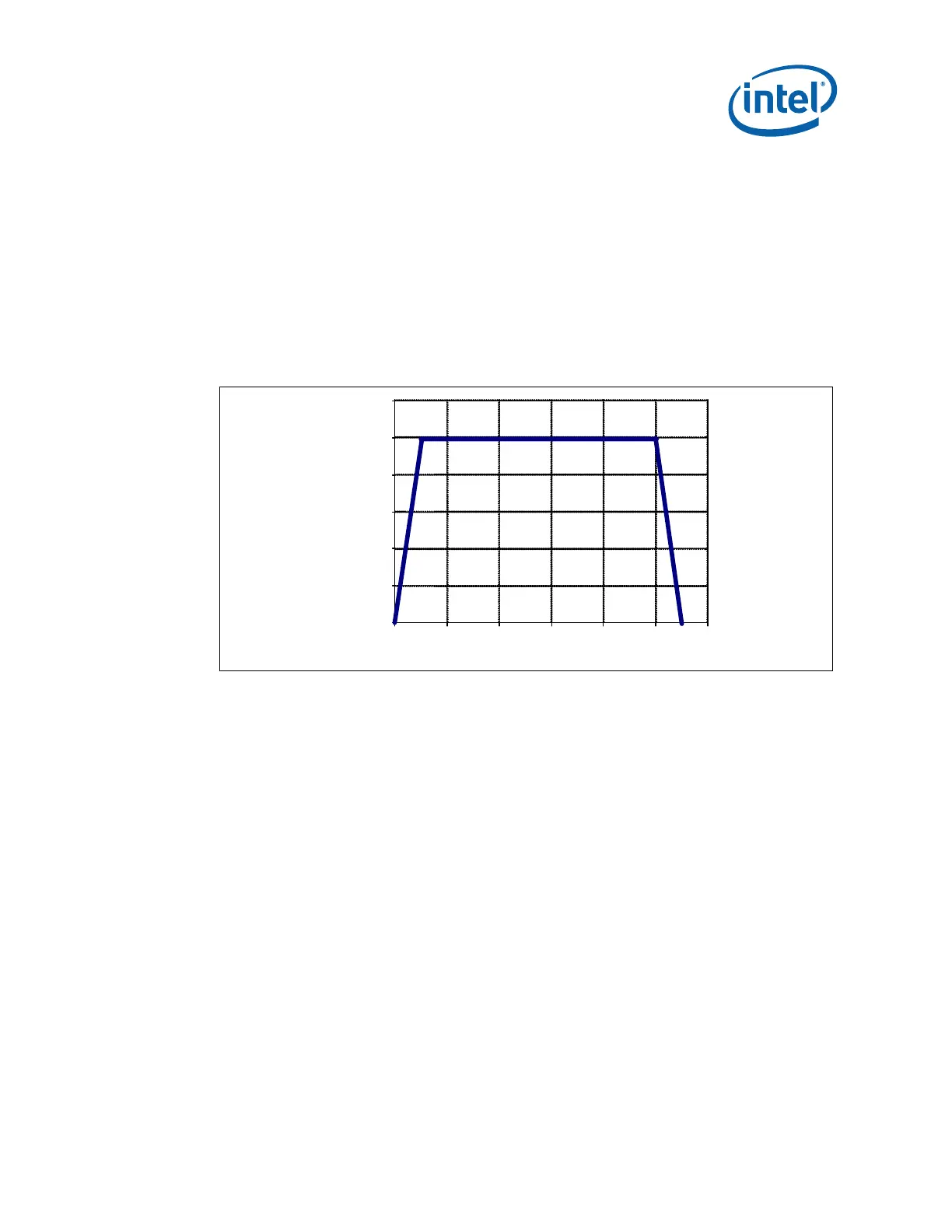
Profile: 50 G trapezoidal waveform, 11 ms duration, 170 in/sec minimum
velocity change.
•
Setup: Mount sample board on test fixture.
Figure 12. Shock Acceleration Curve
0
10
20
30
40
50
60
0
4 6
10 12
Time
milliseconds
A
c
c
e
l
e
r
a
t
i
o
n
(g)
5.2.1.2.1 Recommended Test Sequence
Each test sequence should start with components (i.e., motherboard, heatsink
assembly, etc.) that have never been previously submitted to any reliability testing.
The test sequence should always start with a visual inspection after assembly, and
BIOS/CPU/Memory test (refer to Section 5.2.3).
Prior to the mechanical shock & vibration test, the units under test should be
preconditioned for 72 hours at 45 ºC. The pre-conditioning is intended to present the
system burn-in and shipping/storage environment stress.
The stress test should be followed by a visual inspection and then BIOS/CPU/Memory
test.



 To Next Page