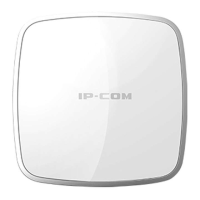
Wireless Access Point
User Guide
7.3 Radio optimization
7.3.1 Overview
WiFi scenarios
WiFi scenarios are mainly divided into two types: ordinary ones and high-density ones.
Ordinary WiFi scenarios
They include WiFi network in places of wide WiFi coverage, such as offices, schools
warehouses and hospitals. In general, comparing with a greater maximum number of clients,
greater WiFi coverage is preferred in these scenarios.
High-density WiFi scenarios
They include WiFi network in large-scale places where a lot of end-user devices are used.
Many APs are deployed for WiFi coverage in these places, such as meeting rooms,
classrooms, stadiums, airports and train stations. In general, comparing with greater WiFi
coverage, a greater maximum number of clients is preferred in these scenarios.
Performance optimization parameters
To fulfill different WiFi requirements in different WiFi scenarios, this AP supports several
radio optimization parameters for users to have better WiFi network.
Prioritize 5 GHz
In general, channels of 2.4 GHz WiFi network are used more frequently and widely than
those of 5 GHz WiFi network. But many channels of 2.4 GHz WiFi network are overlapped
and congested, and interference between WiFi signals is strong as well. Comparatively, 5
GHz WiFi network provides more channels which are not overlapped. However, when
devices supporting both 2.4 and 5 GHz WiFi signals connect to WiFi network, they connect
to 2.4 GHz WiFi network first. This makes the channels of 2.4 GHz WiFi network more
congested and wastes those of 5 GHz WiFi network.
When 5 GHz WiFi signal strength AP receives from an end-user device is higher than AP’s 5
GHz threshold value, prioritize 5 GHz function of the AP enables the device to connect to
AP’s 5 GHz WiFi network first, making more devices to connect to 5 GHz WiFi network and
improving network performance in 2.4 GHz WiFi network.



 To Next Page