7.1.2 How to use filters?
Modern systems offer qualified hardware filters and, if applicable, additional software filters.
Although today’s microprocessors provide a high processing power, the use of hardware filters is still
essential. Especially when users cannot exclude that (periodic) signals can pass the AD converter and
software filter, which cannot process the signals. Every sampling system follows Shannon’s sampling
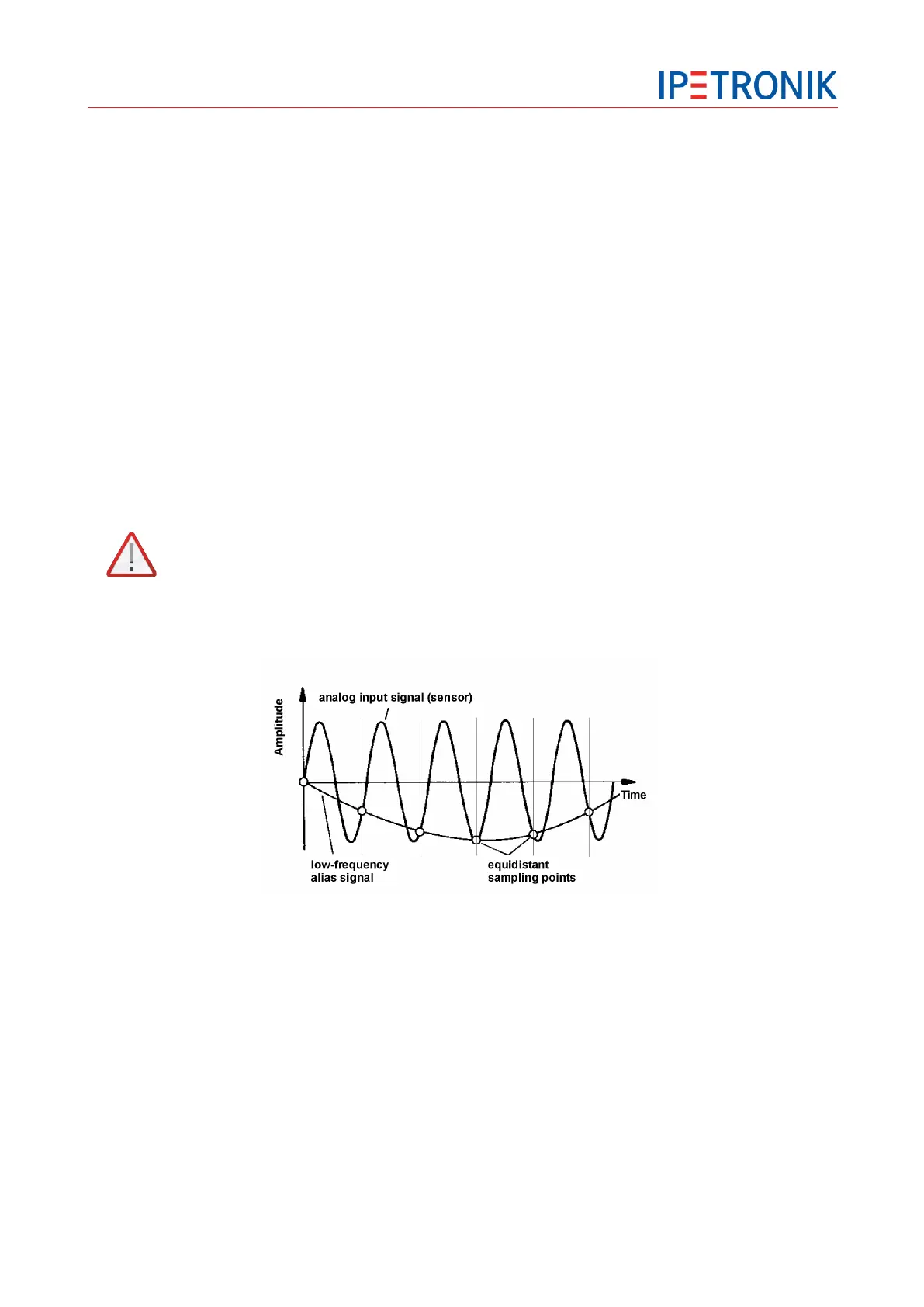
theorem whereby one must at least sample with twice the signal frequency. Otherwise, aliasing effects can
occur, whereas the acquired frequency is considerably lower than the actual signal (see image below).
Why do we additionally filter with DSP?
The hardware filter at the input excludes a distortion by frequency spectra above the system limit with the
maximum sampling rate. Depending on the application, it can be required to lower the cut-off frequency.
Example:
M-SENS devices provide a switchable hardware filter with 150 Hz cut-off frequency. If the cut-off frequency
is e.g. 50 Hz, interrupting frequency spectra (of devices with additional software filter) in the range between
50 Hz and the hardware filter frequency can be filtered with DSP. The filter frequency can be configured in
defined steps up to the hardware filter frequency.
Aliasing effects in spite of hardware and software filter?
Despite sophisticated measurement engineering, errors can occur due to wrong settings. If, for
example, a 100 Hz signal is acquired with a sampling rate of 100 Hz (also the output rate to the
data bus). The system can independently acquire the correct signal, but the result is wrong
because the sampling rate was set too low. If the signal is sent to the bus with a lower
sampling / output rate, the result does not reflect the initial signal.


 To Next Page