ML-46
MevaLite
Gang Forming
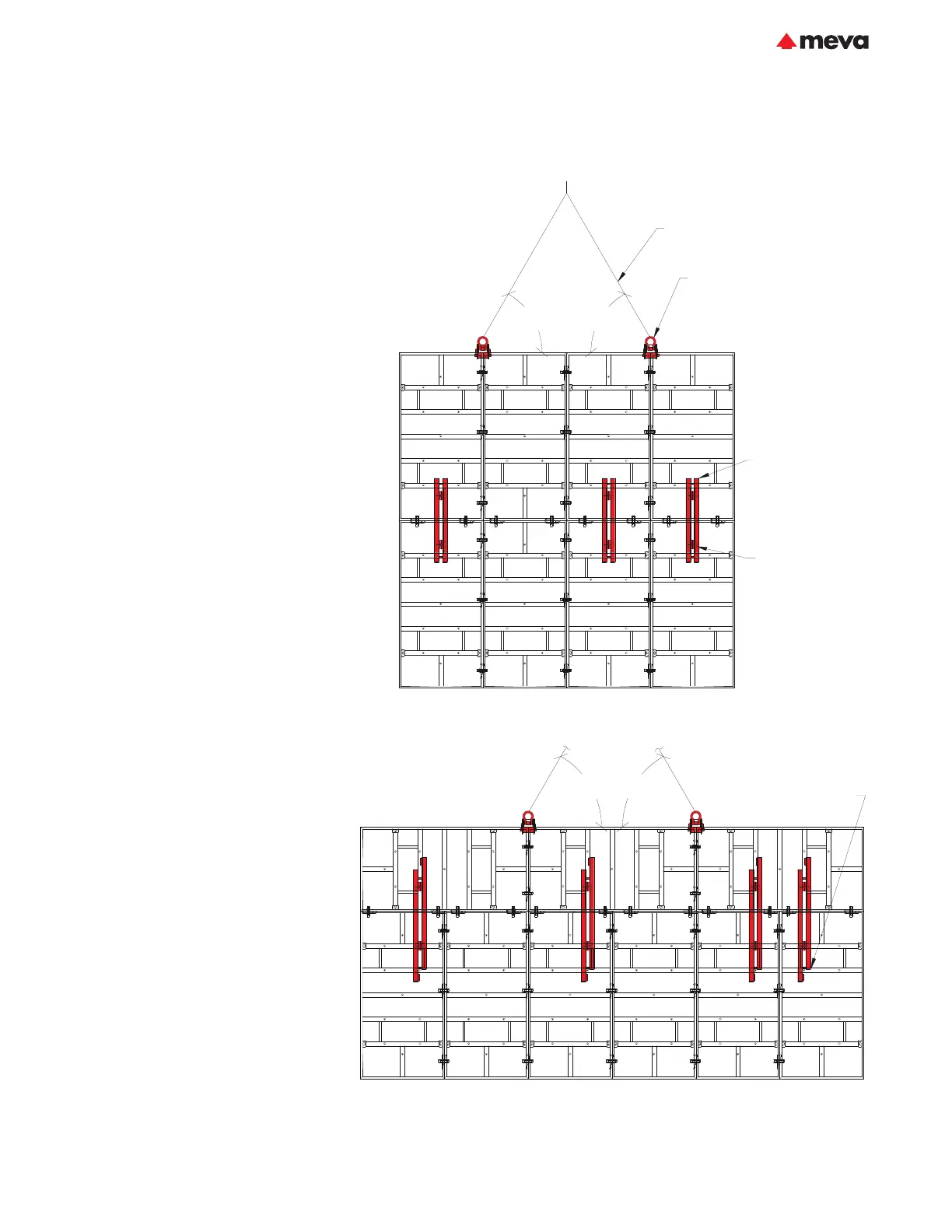
Each crane hook must be attached
at a panel joint (Fig.46.1) or above
a stiffener or panel joint when
the top panels are horizontal. The
number and location of crane
hooks and the rigging arrangement
must be established by the user so
that no individual component is
overloaded. Spreader beams with
load equalizers are recommended
for all but simple two-point lifts.
Vertical steel rails must be installed
across stacked panel joints for
lifting gang forms. The following
rules must be observed:
1. Maximum average rail spacing
is 6'. Rails should be installed on
panels at both ends of each gang.
2. Gangs up to 13' high may use
3' long rails on vertical panels
with (1) flange screw on each side
of the panel joint connected to
the threaded hole in the vertical
end cross member of the panel
(Fig.46.1).
3. Gangs with horizontal panels
require rails that extend to the next
cross member beyond the flange
screw connection of the vertical
panel (Fig.46.2).
4. Gangs over 13' high require
6' rails or longer. Flange screw
connections must be at least
101/2" away from the panel joint,
and rails must extend to the next
cross member beyond the flange
screw connection (Fig.47.1).
Horizontal panels <3' wide may
only be located at the top or
bottom of the gang.
5. Maximum gang height for
single lift is 18'. Higher walls must
be set in multiple lifts, unless
special analysis and design are
performed.
Fig. 46.2 Gang form with horizontal top panels
Rigging (by others), typ.
60° min.
Flange screw 18, typ.
Crane-hook, typ.
Steel rail, typ.
6 x 3 6 x 36 x 3 6 x 3
6 x 3 6 x 3 6 x 3 6 x 3
Rails must extend to next
cross member beyond
flange screw connection
Fig. 46.1 Typical gang form
6 x 3 6 x 36 x 3 6 x 3
R 3'
R 3'
R 3'
60° min.
6 x 3 6 x 3
6 x 3
6 x 3
6 x 3
R 4'
R 4'
R 4'
R 4'
60° min.
60° min.
Wall formwork
Technical Instruction Manual / June 2022


 To Next Page